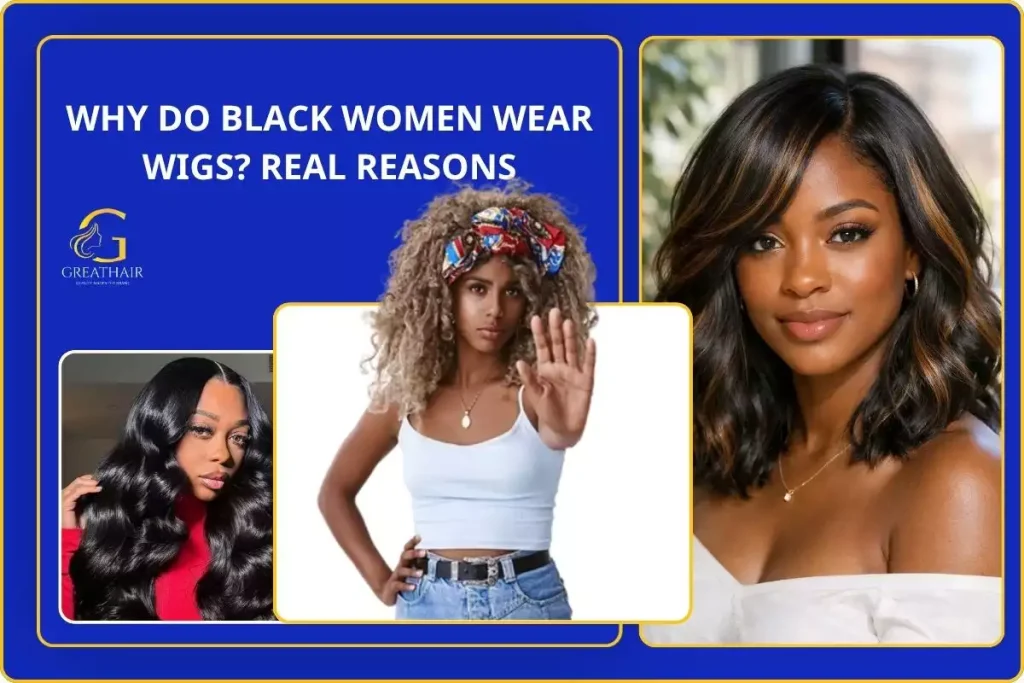
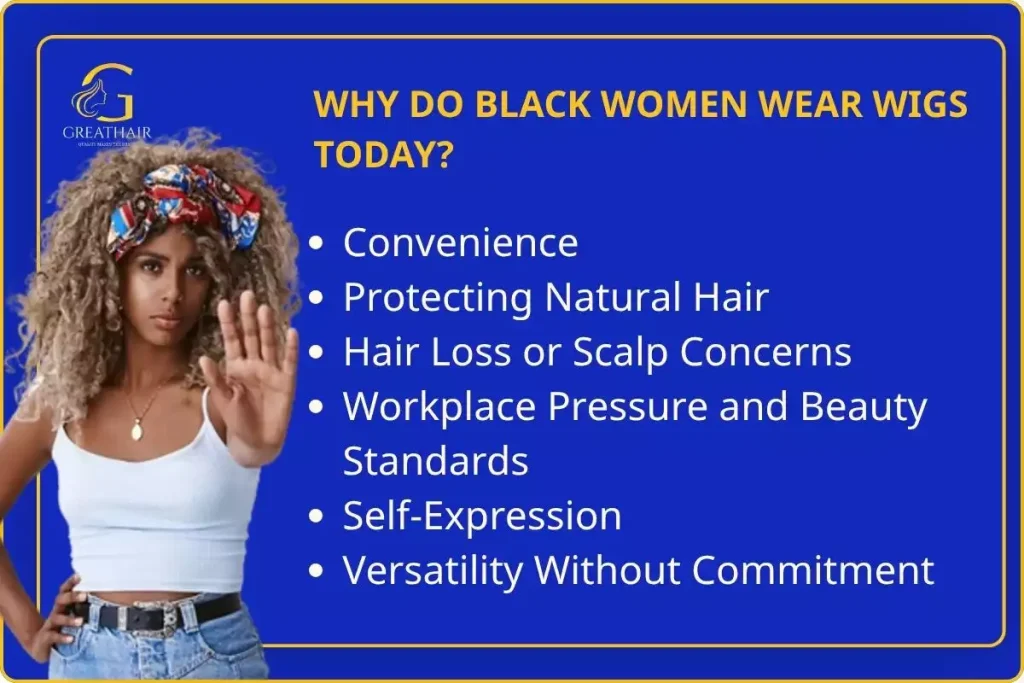
Black women wear wigs for many reasons, including convenience, hair protection, hair loss, workplace pressure, and self-expression. The short answer is simple, but the full answer is more layered than most people think. For some women, wigs are practical. For others, they are protective, expressive, or tied to deeper social experiences. In many cases, they are all of those things at once.
That is why this question can feel both easy and loaded at the same time. Easy, because there are clear reasons people choose wigs. Loaded, because Black hair has never existed in a social vacuum. Hair can be personal, cultural, emotional, and political all at once. So when people ask why Black women wear wigs, the most honest answer is not a single explanation. It is a combination of history, daily reality, beauty, health, and choice.
Read More: What Is a Wig?
A Brief History of Why Black Women Started Wearing Wigs
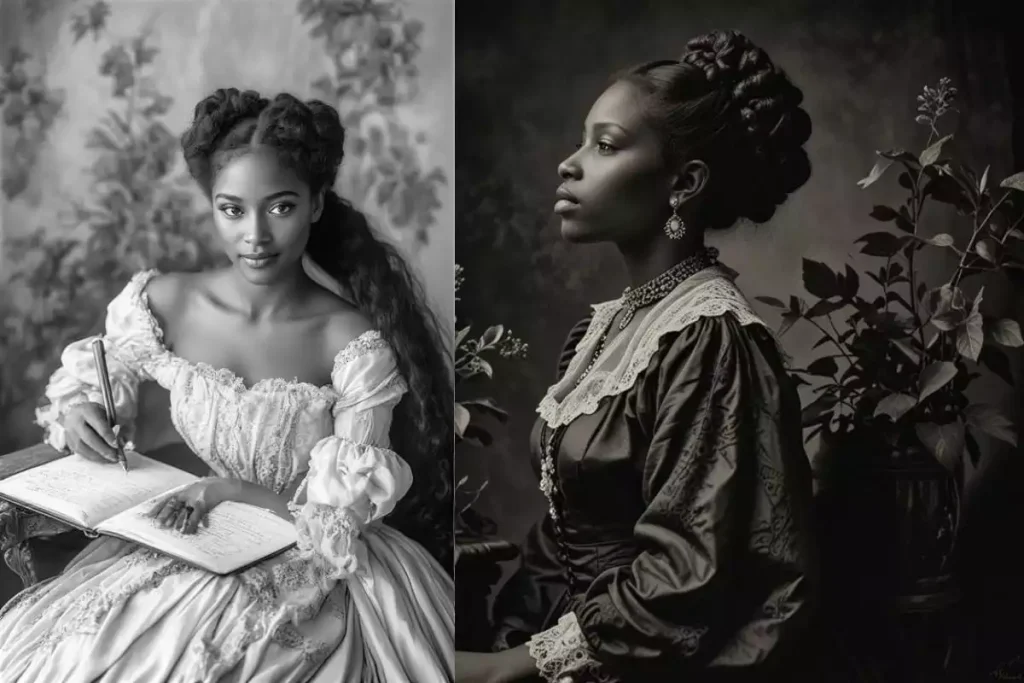
To understand the present, it helps to understand the pressure that shaped the past. In the United States, many Black women came of age in environments where Eurocentric grooming standards were treated as the norm in schools, offices, and public-facing jobs. Straighter, smoother, more controlled-looking hair was often read as more acceptable or more “professional,” while natural Black textures were judged more harshly. In that context, wigs could function as a way to navigate systems that were never designed with Black hair in mind.
That history still matters because it changed the meaning of hair choices. For some women, wigs were once tied to respectability and survival. Today, the picture is broader. Wigs may still intersect with bias and expectation, but they are also connected to freedom, experimentation, and control. The history explains part of the story, but it does not trap the present. What started as adaptation in one era can become flexibility and self-definition in another.
Why Do Black Women Wear Wigs Today?
1. Convenience
One of the most straightforward reasons is convenience. Hair can take time, and time is not a small thing. Between work, caregiving, commuting, school, social life, and plain fatigue, many women want a style that helps them get ready faster without having to manipulate their natural hair every morning. A wig can offer that, especially styles like glueless wigs, which are often chosen for their ease and flexibility. They can cut down styling time, simplify routines, and make it easier to maintain a polished look without starting from scratch every day.
Convenience is not a shallow reason. It is a practical one. People often talk about beauty choices as if they are separate from real life, but they are not. Saving time, reducing effort, and lowering stress are real benefits. In that sense, a wig can be less about appearance and more about ease. For many women, including those who prefer glueless wigs, it can be the hair equivalent of choosing what makes the day more manageable.
2. Protecting Natural Hair
Another major reason is protection. When used thoughtfully, wigs can help reduce daily manipulation of natural hair. Less combing, less heat, less exposure, and fewer repeated styling sessions can all help hair rest. For women trying to retain length, recover from breakage, or simply handle their hair more gently, a wig can be part of a lower-stress routine.
Of course, “protective” is not automatic. Hair specialists warn that tight braids, repeated tension, chemical treatments, and heat can contribute to traction alopecia and other forms of damage. A wig helps only if the hair underneath is also being cared for properly. That means looser installs, reasonable wear times, attention to scalp health, and a willingness to stop when something starts to hurt. Protection is not just about covering the hair. It is about how the whole routine is handled.
3. Hair Loss or Scalp Concerns
Hair loss is part of this conversation too, and it deserves more honesty than it usually gets. According to dermatology guidance, almost half of Black women experience some form of hair loss, and one common cause is traction alopecia linked to tight hairstyles, heat, chemicals, extensions, and other repeated stress on the hair root. That means wigs are not only a style choice for some women. They can also be a way to cope, recover, or feel more like themselves while figuring out what is happening with their hair or scalp.
This matters because hair loss is not only physical. It can be emotional too. A wig can provide softness during a difficult period. It can restore a sense of control when a woman feels like her hair is changing in ways she did not choose. And even when the reason is medical, the decision is still deeply personal. Some women want full coverage. Others want flexibility. Others want privacy. All of those responses make sense.
4. Workplace Pressure and Beauty Standards
Another reason Black women wear wigs is that hair bias still shapes professional life. Research on workplace hair discrimination shows that Black women’s hair is more likely to be perceived as unprofessional, that about two-thirds change their hair for interviews, and that Black women with coily or textured hair are more likely to experience workplace microaggressions. Even more striking, over 20% of Black women ages 25 to 34 in one 2023 study reported being sent home from work because of their hair.
Those numbers do not mean every wig is worn because of pressure. But they do show that hair choices are often made inside a social system, not outside of it. For some women, a wig is simply a sleek style they like. For others, it is also a way to move through spaces that still reward Eurocentric standards, even when those standards are no longer stated out loud. The choice may be personal, but the environment around that choice is not always neutral.
5. Self-Expression
Not every reason is defensive or practical. Sometimes a wig is worn for joy. It gives a woman room to try a different length, texture, part, color, or silhouette without making a permanent change. That freedom matters. Being able to shift your look quickly can feel creative, playful, and empowering. Hair becomes less of a fixed identity and more of a medium.
This is one of the most misunderstood parts of the conversation. Outsiders may see a wig and assume concealment, but many women experience it as expansion. A wig can make style more fluid. It can match a mood, a season, an outfit, or a version of yourself you want to try on for a while. The point is not always to hide what is natural. Sometimes the point is simply to have range.
6. Versatility Without Commitment
That range is also why wigs remain popular: they offer versatility without forcing one long-term decision. A woman can wear one look today and a completely different one next week without cutting, coloring, or heat-styling her own hair into exhaustion. For people who enjoy switching things up, that flexibility is part of the appeal.
And versatility is not just about fashion. It can also be about control. If natural hair feels like it needs a pause, a wig offers one kind of solution. If someone wants a more predictable look for a trip, an event, or a busy season of life, it offers another. In that way, wigs can function less like a disguise and more like an option set.
What People Often Get Wrong About Wigs
The first thing people get wrong is assuming there must be one reason. There usually is not. A woman may wear wigs because they are practical and because they are fun. She may wear them because her hair is thriving and because she wants less daily manipulation. She may wear them because of beauty standards she is tired of fighting and because she likes the look. These reasons do not cancel one another out. They can all be true at once.
The second thing people get wrong is assuming wigs mean a woman does not love her natural hair. Many women move easily between wigs, braids, silk presses, wash-and-gos, twists, blowouts, and natural styles. A wig does not erase natural-hair pride. It simply adds another choice to the rotation. The better question is not whether a wig is “real enough.” It is whether women are allowed the freedom to wear their hair however they want without being judged for it.
Read more: Best Hair Colors For Dark Skin
The Bottom Line
So, why do Black women wear wigs? Because wigs can be practical, protective, expressive, and emotionally supportive all at the same time. They can help with time, styling, hair loss, comfort, bias, experimentation, and personal control. The answer is not one reason. It is a layered one.
In the end, the most useful answer is also the simplest: Black women wear wigs because they choose to, and that choice can carry many meanings. Sometimes the reason is everyday convenience. Sometimes it is health. Sometimes it is beauty. Sometimes it is freedom. And sometimes it is all of those at once.
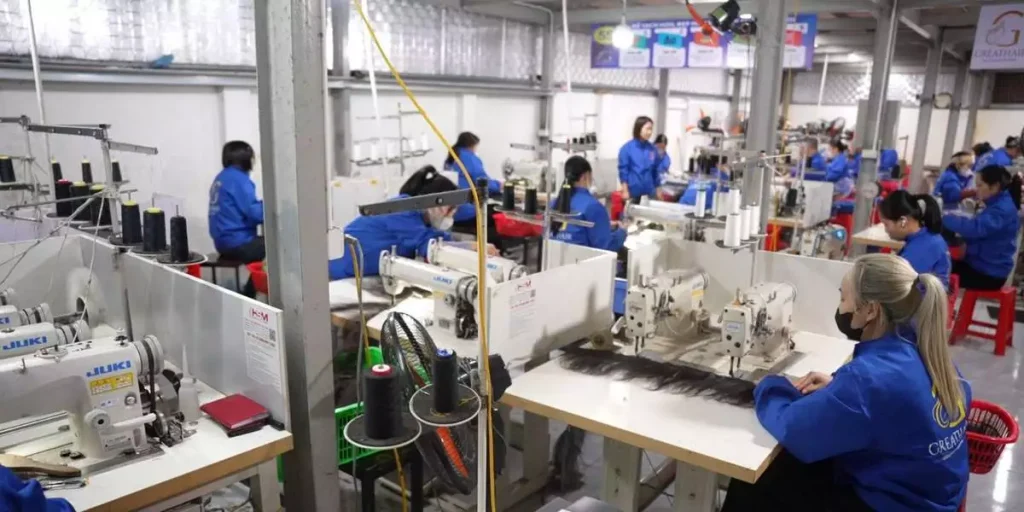
For women looking for wigs that feel comfortable, look natural, and stay easy to wear over time, Greathair’s Vietnamese hair options may be worth considering.
- WhatsApp: (+84) 81 328 2399
- Website: https://greathair.com.vn
- Facebook: greathair.manufacturer
- Instagram: great.hair.manufacturer
- Address: 8, Alley 20/45 Phu Minh Street, Minh Khai Ward, Bac Tu Liem District, Hanoi, Vietnam
FAQ
Are wigs always a protective style?
Not always. A wig can help reduce daily manipulation, but it is only protective when the hair underneath is cared for properly and the install is not too tight. Traction and scalp stress still matter.
Does wearing a wig mean someone dislikes her natural hair?
No. Many women wear wigs and still love wearing their natural hair. A wig is often just one option among many.
Can wigs help with hair loss?
Yes. For some women, wigs can offer comfort, coverage, and flexibility while they manage thinning, traction alopecia, or other scalp concerns.
Are wigs about style or convenience?
Often both. A wig can save time while also making it easier to change length, texture, or overall look without a permanent commitment.
Do workplace standards still influence hair choices?
Yes. Research continues to show that hair bias affects hiring, professionalism judgments, and everyday treatment at work, especially for Black women with textured hair.