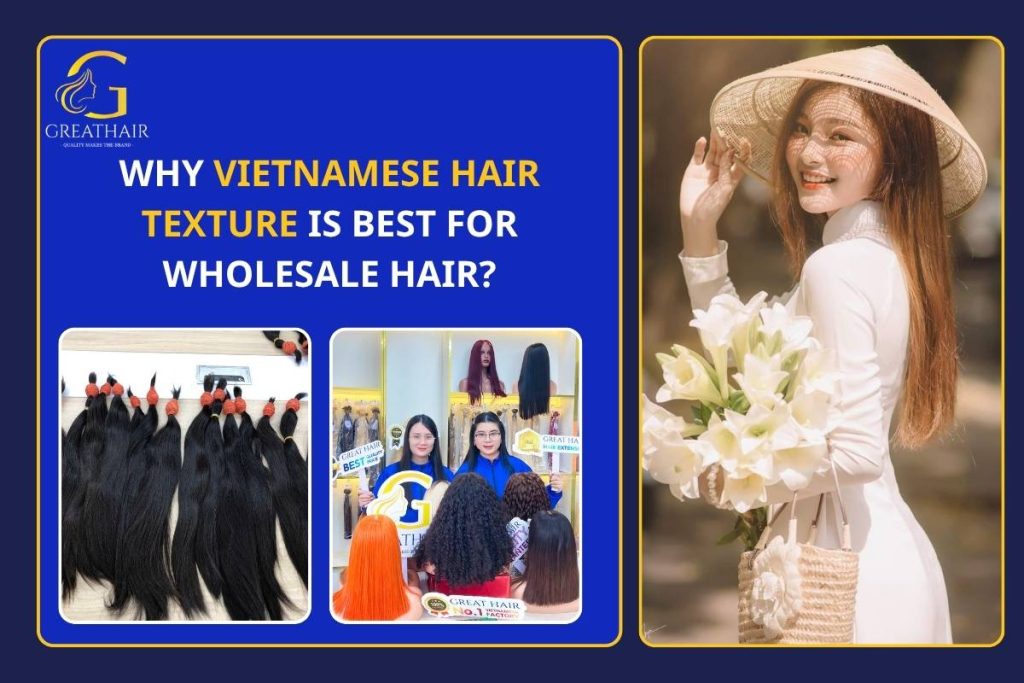
Vietnamese hair texture is one of the strongest foundations for a wholesale collection because it combines natural density, smooth movement, and the strength required for further styling. In its original state, Vietnamese hair is usually straight or softly wavy. From that clean base, a skilled manufacturer can create bone-straight, body-wave, deep-wave, curly, and kinky-straight products for different markets.
For wholesalers, this versatility reduces risk. One reliable hair source can support sleek bundles for Nigerian customers, textured wigs for Black women in the United States, soft waves for European salons, and professional extensions for clients who want discreet length and volume.
The advantage is not that every Vietnamese hair texture is naturally curly or perfectly identical. Many commercial textures are professionally created. What makes Vietnamese hair valuable is the quality of the material beneath the finished pattern and its ability to hold that pattern without losing its soft, luxurious character too quickly.
Why Is Vietnamese Hair a Strong Base for Different Textures
Vietnamese hair works well for wholesale production because its natural straight-to-soft-wave pattern provides a clean starting point for both sleek and textured products. Quality strands are generally strong enough to support controlled heat, steam texturing, coloring, and repeated styling when the processing is performed correctly.
Raw Vietnamese hair should retain its original natural pattern. Bone straight, deep wave, water curly, and other highly uniform designs usually require professional processing, even when the starting material is Vietnamese human hair. A transparent supplier should always separate hair origin from finished texture.
This distinction protects wholesale buyers from a common misunderstanding. “Vietnamese” identifies where the hair comes from, while “body wave,” “kinky straight,” or “bouncy curly” describes the finished appearance. The quality of the final product depends on both the original hair and the method used to create its texture.
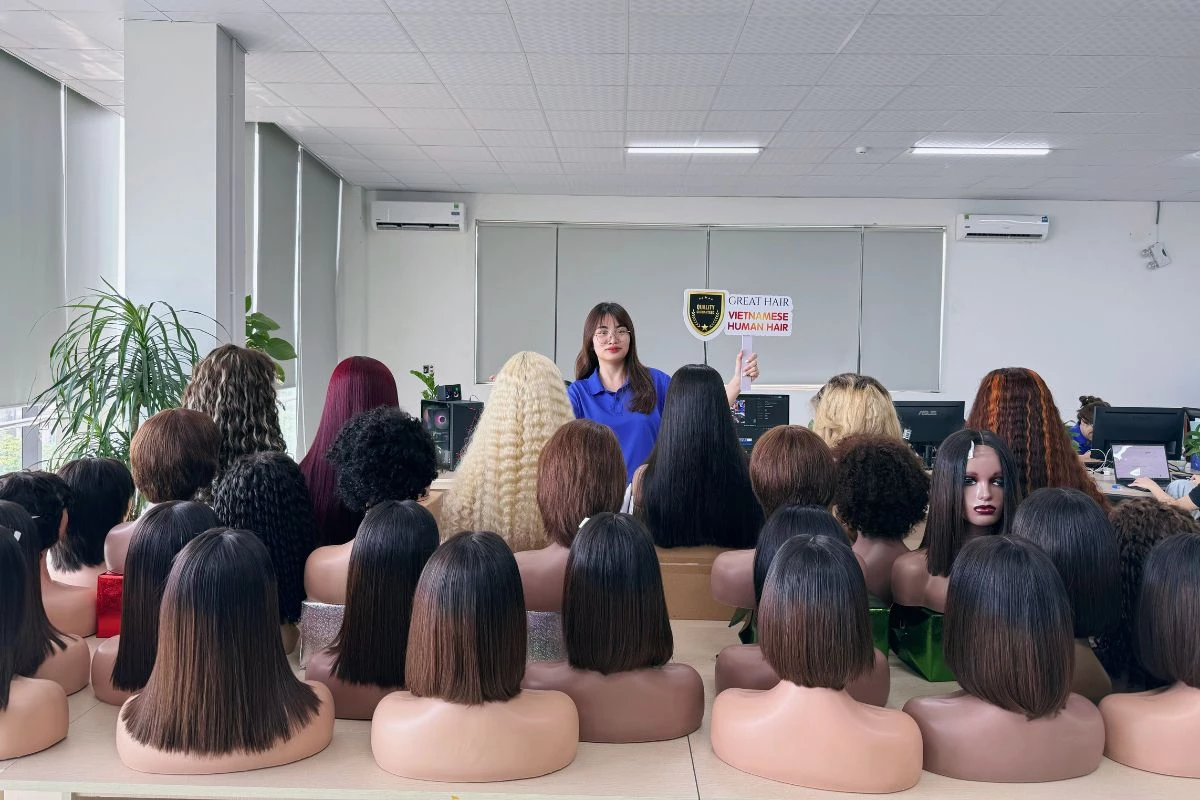
GreatHair’s current Vietnamese hair texture chart includes bone straight, natural wavy, body wavy, loose wavy, deep wave, bouncy curly, Fumi curly, twist curly, deep twist curly, water curly, Burmese curly, Jerry curly, pixie curly, and kinky straight.
Which Hair Texture Fits Each Wholesale Product
The best texture depends on how the hair will be installed and maintained. A pattern that looks beautiful on a full wig may not be the most practical choice for tape-ins, while hair intended for leave-out should blend with the customer’s own texture.
| Wholesale product | Recommended textures | Why they work |
|---|---|---|
| Machine-weft bundles | Bone straight, body wave, loose wave, deep wave | Familiar, versatile products that salons can install and customize |
| Closures and frontals | Straight, body wave, deep wave, water curly | Matching texture creates a seamless finish across the full installation |
| Glueless and lace wigs | Bone straight, kinky straight, body wave, bouncy curly | Offers both polished and natural-looking ready-to-wear options |
| Tape-ins and keratin extensions | Natural straight, bone straight, soft wave | Smoother textures separate cleanly and are easier to install precisely |
| Bulk hair for wig makers | Natural straight, kinky straight, curly textures | Gives professionals greater freedom for ventilation and custom construction |
| Clip-ins | Straight, body wave, kinky straight | Supports quick styling while offering different levels of volume and blend |
Length also changes how a texture appears. The same weight of 28-inch curly hair looks less full than an 18-inch curly bundle because the strand travels through more bends and the finished length is measured differently. Wholesale buyers should therefore confirm stretched length, finished appearance, bundle weight, and end fullness rather than ordering by texture name alone.
A Practical Texture Matrix for Different Markets
There is no single hair texture that sells equally well in every country. The safest wholesale strategy is to build a starting collection around proven commercial styles and adjust it using local sales data, customer photographs, climate, installation habits, and price level.
The following matrix is a practical starting point, not a claim that every customer within a region wants the same look.
| Market and customer profile | Strong starting textures | Suitable products |
|---|---|---|
| Nigeria and West African premium buyers | Bone straight, body wave, deep wave, curly | Bundles, closures, frontals, lace wigs |
| United States and Canadian textured-hair clients | Kinky straight, body wave, deep wave, water curly | Glueless wigs, frontal wigs, bundles, custom units |
| United Kingdom and European salon clients | Natural straight, body wave, loose wave | Wigs, wefts, tape-ins, keratin extensions |
| Caribbean and humid-climate customers | Deep wave, water curly, kinky straight | Wigs, bundles, closures |
| Premium custom-color market | Natural straight and soft natural wave | Raw bundles, bulk hair, wigs for professional coloring |
| Everyday ready-to-wear market | Bone straight, body wave, bouncy curly | Glueless wigs, closure wigs, clip-ins |
GreatHair’s experience with Nigerian buyers shows why the matrix must connect texture with product. Bone straight serves customers seeking a sleek luxury finish, while body wave adds soft volume and deep-wave or curly products create a fuller look. Bundles remain flexible for salons, whereas closures, frontals, and glueless wigs suit businesses selling completed or nearly completed styles. These preferences are reflected in GreatHair’s guide for Nigerian hair vendors.
A new reseller should not launch all available textures at once. Begin with two reliable core textures, one premium style, and one texture that reflects the needs of the local customer. Sales results will reveal where the collection should expand.
What Do Wholesale Buyers Really Expect from Hair Texture
Wholesale buyers are not only purchasing a curl pattern. They need the same pattern, fullness, softness, and movement to return in the next shipment.
A deep-wave sample can look beautiful under studio lighting but still create problems if the bulk order arrives with looser sections, thinner ends, or a different curl diameter. Likewise, bone-straight hair may appear sleek in photographs while becoming dry or puffy after its finishing product is washed away.
Experienced buyers therefore judge texture through four moments. They inspect it when dry, wash it, allow it to air-dry, and compare it with another bundle from the same batch. For curls and waves, they also check whether the pattern returns after washing without excessive manipulation.
With our experience in Vietnamese human hair manufacturing since 2008, GreatHair has found that texture consistency becomes more important as a hair business grows. A small variation may be manageable in a custom salon order, but the same variation across 100 private-label wigs can affect product photography, reviews, and customer trust.
Natural Texture and Processed Texture Need Different Expectations
Natural Vietnamese hair offers subtle variation, while processed texture is designed to deliver a more uniform commercial appearance. Neither is automatically better; each serves a different wholesale purpose.
Raw natural straight or wavy hair is ideal for premium buyers who value authenticity, custom coloring, and individual movement. Professionally processed textures are better when a reseller needs predictable curls, waves, or a sleek bone-straight finish across a collection.
The processing method must suit the strength of the hair. Overprocessing can produce a beautiful pattern at first while leaving the strands dry, fragile, or difficult to manage after several washes. Underprocessing creates the opposite problem, with curls relaxing too quickly or varying from one section to another.
For this reason, buyers should ask whether a texture is natural, heat-set, steam-textured, or chemically permed. The answer affects maintenance instructions, coloring limits, and how the product should be presented to customers.
A Real Texture Inspection at GreatHair
During one GreatHair quality-control session, hair specialist Alice Bonita reviewed approximately 10 kilograms of Vietnamese hair with the production team. Closer inspection revealed short strands, weaker ends, and sections that did not match the direction required for the finished texture. Only around eight kilograms were accepted for premium production, while approximately two kilograms were removed. Alice’s inspection demonstrated that beautiful texture begins before curling or straightening—the raw material must first be consistent enough to produce a dependable finished collection.
Alice Bonita is publicly identified by GreatHair as a hair-extension specialist with more than 18 years of experience in sourcing, quality control, and supplying Vietnamese hair. The original factory case appears in GreatHair’s article about unprocessed hair extensions.
How Should Buyers Test Texture Before a Bulk Order
Wholesale buyers should approve washed samples rather than relying only on photographs or texture names. Each factory may define “deep wave,” “water curly,” or “kinky straight” differently.
Before ordering, confirm the following:
- Request a current texture sample
Test hair from a recent production batch, not an old showroom piece. - Wash and air-dry the hair
Check whether the pattern returns and whether the ends remain manageable. - Compare matching products
A closure, frontal, and bundle sold as the same texture should blend together. - Test the intended styling process
If customers will straighten, recolor, or restyle the hair, test those services on the sample. - Approve measurable specifications
Confirm curl size, stretched length, bundle weight, density, fullness, color, and acceptable variation.
The approved sample should be kept as a reference for the bulk shipment. This gives both buyer and manufacturer a clear standard instead of relying on subjective descriptions such as “very curly” or “luxury texture.”
Where to Buy Quality Vietnamese Hair
Wholesale buyers should work with a Vietnamese hair manufacturer that can connect texture, product construction, and market demand. A large texture catalog is useful, but consistent reproduction, clear processing information, and sample-to-bulk matching are more important.
GreatHair manufactures Vietnamese hair products for salon owners, wig makers, resellers, distributors, and private-label brands. Its factory produces natural and professionally textured hair across bundles, bulk hair, closures, frontals, wigs, tape-ins, clip-ins, and keratin extensions.
Buyers can confirm texture, length, weight, fullness, color, lace construction, wig density, packaging, and intended market before production. Samples and quality-control photographs or videos can also be requested before increasing the order volume.
Explore the GreatHair texture chart or contact the wholesale team to develop a texture matrix for your market, target price, and product collection.
GREATHAIR – PREMIUM VIETNAMESE HUMAN HAIR MANUFACTURER
About GreatHair Vietnam transforms authentic Vietnamese hair into premium wigs and extensions trusted by beauty professionals and brands worldwide. Our commitment is clear: deliver manufacturing excellence, ethical practices, and long-term customer success under the slogan “Quality Makes The Brand.”
Ready to order quality curly human hair extensions at wholesale prices? Contact our sales team:
- WhatsApp: (+84) 81 328 2399
- Website: https://greathair.com.vn
- Facebook: greathair.manufacturer
- Instagram: great.hair.manufacturer
Frequently Asked Questions
What is the natural Vietnamese hair texture
Natural Vietnamese hair is usually straight or softly wavy. Highly uniform curls, waves, and bone-straight finishes generally require professional processing.
Which Vietnamese hair texture sells best wholesale
Bone straight, body wave, deep wave, and curly textures have broad commercial appeal. The strongest choice still depends on the buyer’s country, product type, and target customer.
Is kinky straight Vietnamese hair natural
Kinky straight is usually a professionally created texture made to resemble stretched or blow-dried natural hair. Buyers should ask how the texture was produced.
Can curly Vietnamese hair be straightened
Many quality curly products can be temporarily straightened with controlled heat, but repeated high temperatures may loosen the curl pattern. Test the actual sample first.
How can buyers check texture consistency
Wash and air-dry several samples, compare the curl pattern and end fullness, and confirm that bundles, closures, frontals, and wigs labeled with the same texture blend correctly.