



There are no products in the cart
Oct 24, 2025
Post by Alice Bonita
Straight Vietnamese hair usually refers to Vietnamese-origin human hair sold in a naturally straight or near-straight texture. For buyers in the US and EU, the appeal is simple: it gives a cleaner silhouette, a smoother fall, and a fuller look than lighter, finer textures when the hair is well sourced and well aligned. Asian hair is widely described in the literature as straighter, rounder in cross-section, and larger in diameter than other broad hair-group categories, which helps explain why sleek Vietnamese textures are so popular in extensions and wigs.
That said, straight Vietnamese hair is not one thing. Some bundles are naturally straight, some are steam-shaped into a flatter finish, and some only look good before the first wash. This is why the real question is not whether the label says “straight Vietnamese hair,” but whether the fiber quality, cuticle condition, density, and processing level support that look over time.
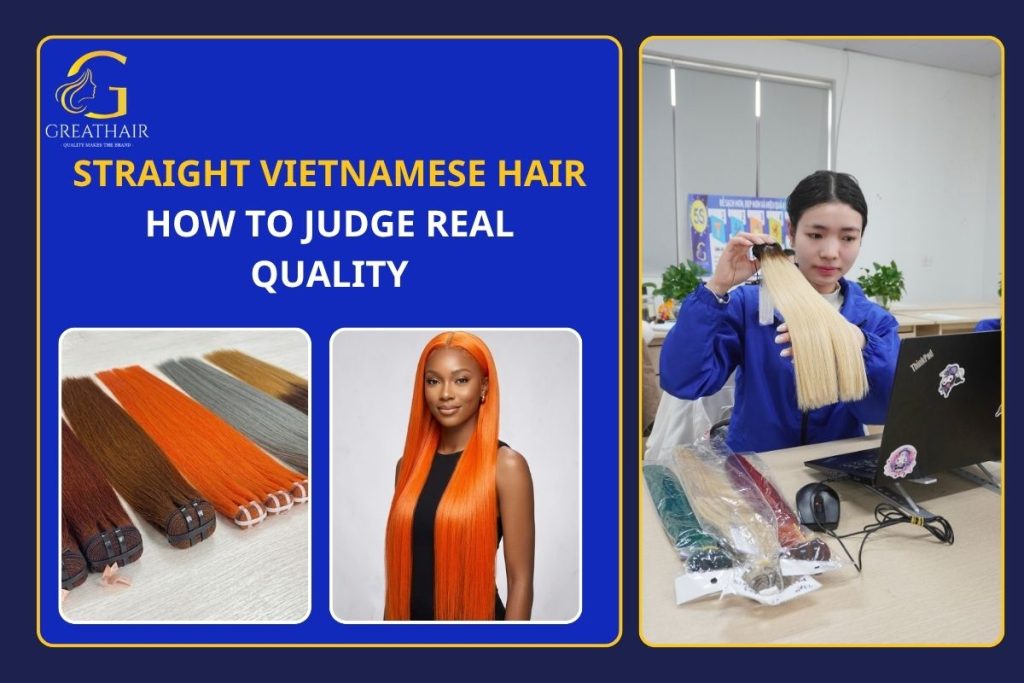
At its best, straight Vietnamese hair means human hair sourced from Vietnam that already has a straight or low-wave tendency and can fall smoothly without fighting the style. In the broader science of hair morphology, Asian hair is commonly described as straight, dark, and larger in diameter, with thicker and more compact cuticle layers than Caucasian hair, which helps explain the smooth surface and substantial hand-feel people often associate with premium straight Vietnamese hair.
In real buying situations, this texture sits between “natural straight” and “ultra-flat salon straight.” Natural straight Vietnamese hair usually still has a soft, lived-in movement. It does not always look pin-flat straight out of the box, and that is often a good sign. A little movement can indicate the hair has not been pushed too far through aggressive processing.
>> Read More: Understanding Vietnamese Hair Quality.
The short answer is structure. Straighter fibers align more easily, and better fiber alignment creates a cleaner reflection of light, which is why straight hair usually reads as smoother and glossier than hair with more irregular movement. Research on hair appearance shows that synchronized alignment improves visible luster, while meandering fibers and surface damage make hair look duller and less defined.
This matters in practice because straight Vietnamese hair is often chosen for installs that need a polished finish rather than airy softness. The fuller look does not only come from density at the weft or cap; it also comes from how the strands lie together. When fibers fall in a continuous sheet, the silhouette looks sharper, the ends appear cleaner, and the style reads more expensive even before heavy styling.
For buyers in the US and EU, this is one of the biggest reasons the texture works so well in wigs, machine wefts, genius wefts, and custom units. It gives stylists a reliable base for sleek middle parts, blunt ends, glass-hair finishes, and straight layered looks without needing the hair to fight its natural behavior.
These two terms are related, but they are not the same. Straight Vietnamese hair usually refers to a natural-looking straight texture with some softness and movement. Bone straight hair usually refers to a flatter, more rigidly sleek finish that looks extra smooth and uniform from top to bottom.
That difference matters because a more “perfect” straight finish can also mean more intervention somewhere in the production chain. Not every bone straight product is low quality, but buyers should understand that the flattest finish on the market is not always the most natural state of the fiber. If your priority is softness, easy restyling, and a more believable everyday finish, natural straight Vietnamese hair is often the better choice. If your priority is a high-gloss, fashion-led, ultra-sleek result, bone straight may be the better fit.
A useful way to think about it is this: natural straight Vietnamese hair is easier to trust when you want long-term flexibility, while bone straight hair is easier to choose when the finished look matters more than texture versatility.
This texture works best for buyers who want control, polish, and consistency. It is especially strong for sleek wigs, sew-ins, wefts, and custom extensions where the goal is a clean line rather than a fluffy or textured finish.
Straight Vietnamese hair tends to suit:
It can still work for textured-hair clients, especially in wigs, but the decision should be based on the final look rather than origin alone. Straight texture is most convincing when it matches the styling goal, the density plan, and the wearer’s maintenance habits.
The fastest way to judge straight Vietnamese hair is to look past the keyword and inspect the evidence. “Vietnamese” and “straight” are not quality guarantees by themselves. You need to know how the hair was sorted, aligned, processed, and finished.
Use this checklist before you place an order:
A strong straight bundle should feel smooth without feeling overly coated. If the shine looks artificial, the ends separate too easily, or the hair loses order after light handling, the straight look may be cosmetic rather than structural.
Good straight Vietnamese hair should still look organized after washing, even if it is not salon-flat. It may dry with a softer line than it had out of the package, but it should not turn rough, puffy, or confused in pattern after one wash. Hair that becomes frizzy immediately often signals coating, over-processing, or poor cuticle condition.
Heat styling should be used with discipline, not force. Dermatologists note that excessive heat can damage hair, and flat irons should be used on dry hair on a low or medium setting rather than pushed aggressively day after day. They also advise minimizing handling of wet hair because wet hair breaks more easily.
For wigs made with human hair, Cleveland Clinic notes that natural human hair wigs can be cut, styled, and dyed like your own hair, and they generally last longer than synthetic options, but they still need gentler handling and low heat when blow-drying.
In practical terms, the best result usually comes from light product use, low-to-moderate heat, and a routine built around preserving cuticle smoothness instead of correcting damage after it appears.
The best care routine is usually the simplest one. Straight hair holds a polished look well, but it also reveals buildup, rough brushing, and overheating faster than textured styles do.
A reliable maintenance routine looks like this:
If the hair is installed tightly as extensions or a weave, scalp health matters just as much as fiber care. The American Academy of Dermatology warns that pain, headache, or constant pulling are signs the style is too tight, and ongoing tension can lead to breakage or even traction-related hair loss.
Care should preserve the texture’s natural order. When maintenance becomes constant rescue work, the quality was probably wrong at the start.
Straight Vietnamese hair usually disappoints for one of two reasons: buyers expected the label to do the quality control for them, or they treated premium hair like disposable hair. Most problems happen long before the hair “fails.”
Common mistakes include:
Avoiding these mistakes usually leads to better retention, better styling results, and fewer returns or complaints.
Usually yes, but not always perfectly flat. Natural straight Vietnamese hair often has a soft movement rather than a rigid, pin-flat finish.
No. Straight Vietnamese hair usually looks more natural, while bone straight hair is a flatter, more polished finish.
Straighter alignment and a more substantial fiber diameter can make the hair read denser and cleaner in silhouette. Broad scientific reviews of Asian hair describe it as straighter and larger in diameter than other broad ancestry-group averages.
Yes. Human hair wigs are generally more style-flexible and longer-lasting than synthetic wigs when cared for properly.
Yes, but the safe limit depends on the real quality, previous processing, and color history. Always judge bleaching ability by actual strand condition, not just the supplier claim.
Good-quality straight Vietnamese hair should tangle less than mixed or poorly aligned hair, but any hair can tangle if the cuticles are rough, the ends are dry, or the product is over-processed.
Check whether it stays smooth after washing, whether the ends remain consistent, whether the supplier discloses processing clearly, and whether the hair moves naturally on video.
Yes, especially for buyers who want sleek installs, consistent color work, and a polished finish that suits modern salon demand in those markets.
Straight Vietnamese hair is popular for a reason: when the quality is real, it gives a smooth fall, a fuller visual line, and a polished finish that works exceptionally well for wigs and extensions. The smartest way to buy it is to treat “straight Vietnamese hair” as a starting point, then judge the actual fiber, processing level, and post-wash performance before you trust the label.
If you want beautiful, soft hair and a reliable supplier, GreatHair is the place to start.

We Will Contact You Shortly



Address: 8 Ngo 20/45 D. Phu Minh, Minh Khai, Bac Tu Liem, Ha Noi, Viet Nam
Phone: (+84)813282399

There are no products in the cart