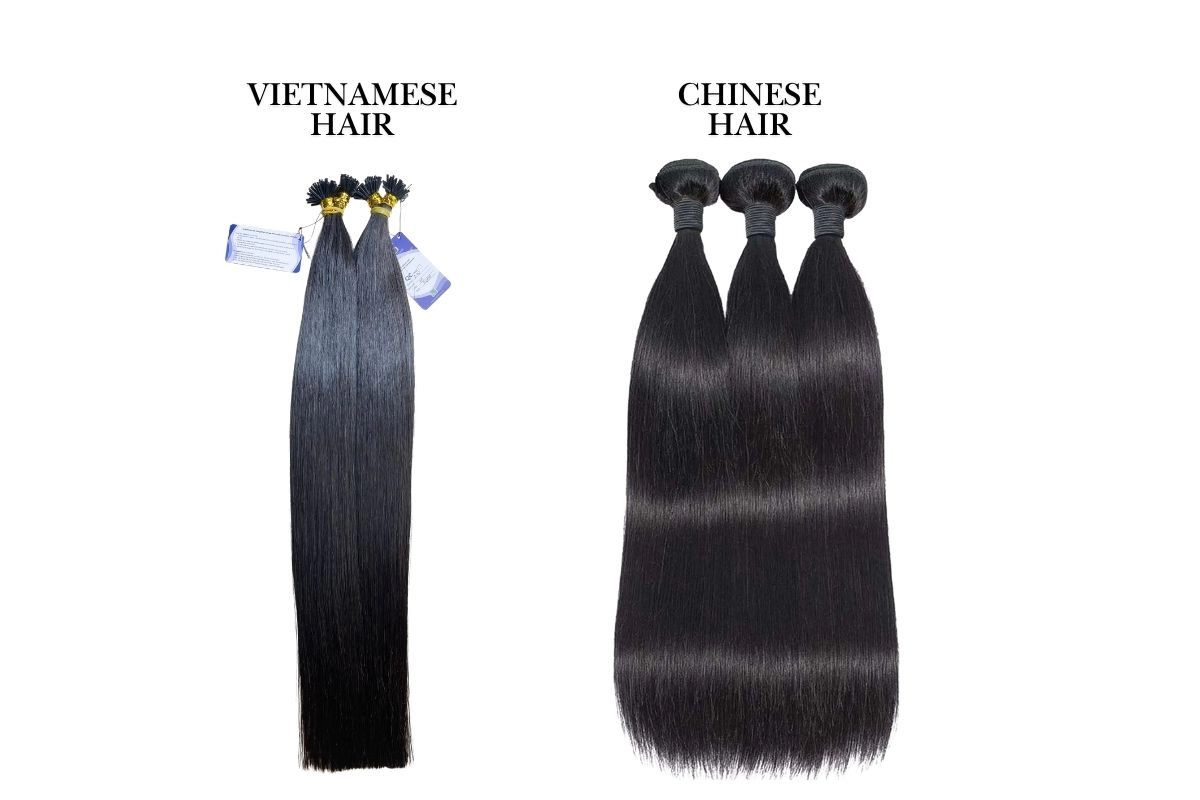
When buyers compare Vietnamese hair vs Chinese hair, the real difference is not only price. It shows when you hold the bundle, touch the strands, look at the ends, wash the hair, and see how it behaves after real use.
Vietnamese hair usually feels stronger, fuller, and more natural. Chinese hair can look very smooth at first, but many low cost options rely more on processing, coating, or mixed hair sources. That is why two bundles may look similar in photos but perform very differently after washing.
The answer buyers need before orderin
Vietnamese hair is usually the better choice for buyers who want strong strands, fuller ends, natural movement, better bleaching results, and longer wear. It works well for salons, resellers, wig makers, distributors, and private label brands that sell premium hair.
Chinese hair is usually more affordable and easier to find in large stock. It can work for budget lines, ready made wigs, trendy colors, and fast moving products. The risk is that quality can change a lot from one supplier to another, especially when the hair has been heavily processed or coated.
So the simple answer is this. Choose Vietnamese hair for long term quality. Choose Chinese hair only when price, quantity, or ready made variety matters more.
What Vietnamese hair really feels like
Vietnamese hair is human hair collected from Vietnam and used for extensions, wigs, closures, frontals, and bulk hair. Good Vietnamese hair is known for its natural dark color, strong fiber, smooth surface, and healthy movement.
The special point is the strand. Vietnamese hair often feels firm and dense when you hold it. It does not need to look too glossy to appear beautiful. A natural shine is better than a plastic like shine because overly shiny hair may come from coating.
For premium buyers, Vietnamese hair is valuable because it can stay soft after washing, handle styling better, and keep a fuller look from top to ends when the grade is good. You can learn more about its natural quality in Understanding Vietnamese Hair Quality.
Stronger strands with natural movement
Good Vietnamese hair usually has a clean fall. When you shake or comb the bundle, the hair moves naturally instead of looking too flat or artificial.
This is important for salons and wig makers because customers do not only judge hair on the first day. They judge it after washing, brushing, curling, straightening, and wearing it in real life.
Fuller ends that look more premium
The ends tell a lot about hair quality. Good Vietnamese hair often looks fuller through the length, especially in double drawn and super double drawn grades.
Fuller ends make the final hairstyle look richer. This matters most for long lengths because thin ends are easy to notice after installation.
What Chinese hair often looks like at first
Chinese hair can mean hair collected in China, but in the global hair market, it often refers to hair manufactured or processed through Chinese factories.
Chinese suppliers are strong in large scale production. They often offer many wigs, bundles, tape ins, clip ins, keratin tips, colors, and textures. This is useful for sellers who need fast stock and many product choices.
The main issue is consistency. Some Chinese hair is good, but many cheap options may be mixed, chemically treated, or coated to look silky when new.
Very soft touch can be misleading
Soft hair does not always mean strong hair. Some Chinese hair feels extremely soft at first because the surface has been treated or coated.
The problem appears after washing. When the coating fades, the hair may become dry, rough, thin, or easier to tangle. That is why buyers should not only ask if the hair feels soft. They should ask if the hair still feels soft after washing.
Processing can hide the real condition
Processed hair can look beautiful in photos and videos. It may look smooth, shiny, and uniform. But if the strand has already been weakened by chemicals, the beauty may not last.
This does not mean all Chinese hair is bad. It means buyers need to test more carefully before bulk orders.
The difference becomes clear after washing
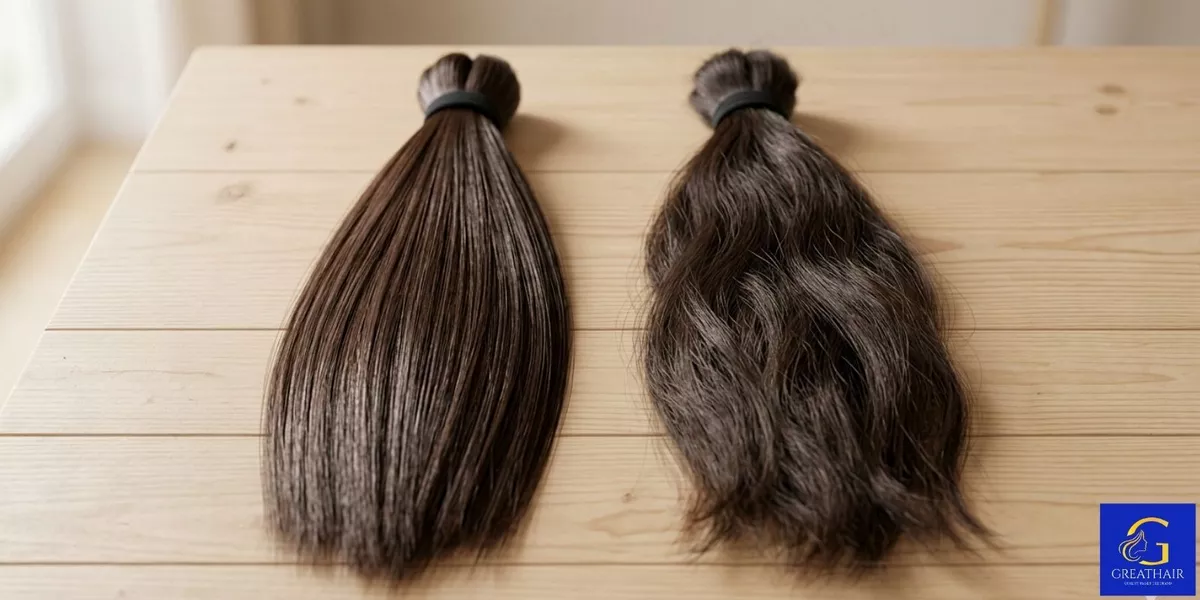
The biggest difference between Vietnamese and Chinese hair is easier to feel than explain. Photos can hide problems. Wet videos can make almost any hair look smoother. A wash test shows the truth.
Good Vietnamese hair should still feel manageable after shampooing and air drying. The movement should remain natural, and the strands should not become stiff or rough too quickly. With Chinese hair, the result depends heavily on grade and processing. High quality Chinese hair can still perform well, but cheap processed hair may lose shine and softness after a few washes.
See Our Real Vietnamese Hair vs Chinese Hair Wash Test
In this video, we compare two hair bundles under the same test conditions: first touch, strand feeling, washing, air drying, brushing, end fullness and natural movement. The test was recorded by the GreatHair team to help salons, resellers and wig makers see the difference beyond product photos.
Vietnamese Hair vs Chinese Hair Comparison Table
| What buyers should check | Vietnamese hair | Chinese hair |
|---|---|---|
| First touch | Soft but still firm | Very soft and sometimes slippery |
| Strand feeling | Stronger and denser | Can feel thinner if processed |
| Ends | Fuller in good grades | May become thin at the bottom |
| Shine | Natural shine | Can look glossy from coating |
| After washing | Usually stays more stable | Quality may drop if coating fades |
| Bleaching | Better when raw or high quality Remy | Riskier if already processed |
| Price | Higher upfront cost | Lower starting price |
| Best for | Premium salons and brands | Budget lines and fast stock |
The ends reveal the real quality
If you want to judge hair quickly, do not only touch the top of the bundle. Look at the ends.
Good Vietnamese hair often keeps better fullness from top to bottom. The bundle does not look heavy near the weft and empty at the bottom. This gives the hair a more premium look after installation.
Lower grade Chinese hair may look full at the top but weak near the ends. For customers buying long hair, this difference can decide whether they feel happy or disappointed.
Bleaching shows which hair is stronger
For buyers who need blonde, highlights, balayage, piano color, or custom wig colors, Vietnamese hair is usually the safer choice.
High quality Vietnamese hair often starts from a natural dark base and may be less chemically processed when sourced correctly. This gives stylists more control during coloring.
Chinese hair can also be colored, but only if the quality is suitable. If the hair has already been dyed, acid treated, steamed, or coated, bleaching can cause dryness, uneven color, or breakage.
Which hair should buyers choose
Vietnamese hair works best for businesses that want to build a premium line. The stronger strands, fuller ends, and more stable after wash quality make it easier to sell to customers who care about long wear and natural movement.
Chinese hair still has value in the right market. Its strength is variety, fast production, ready made styles, and lower starting cost. That makes it useful for budget collections or trend based products where speed and price matter more than long term performance.
The safest decision is not based on the country name alone. A serious buyer should look at the strand, the ends, the washing result, the bleaching test, and the supplier’s proof before placing a bulk order. You can also compare Vietnamese hair with other origins in The Difference Between Vietnamese Hair and Other Hair.
The smarter choice is the one your customers trust
Vietnamese hair and Chinese hair do not compete in the same way. One is often valued for stronger strands, fuller ends, and better long term wear. The other is known for lower entry cost, large stock, and wider ready made options.
For a hair business that wants to build trust, the better choice is not always the cheapest bundle. It is the hair that still looks good after washing, feels natural after styling, and gives customers fewer reasons to complain.
That is why many premium salons, resellers, distributors, and private label brands prefer Vietnamese hair for their main product line. With stable quality, QC videos, sample support, and factory direct supply, Great Hair Vietnam helps buyers choose hair with more confidence before moving into larger wholesale orders. For verified partners, check the Top 5 Reliable Vietnamese Hair Factories.
- WhatsApp: (+84) 81 328 2399
- Email: [email protected]
- Facebook: greathair.manufacturer
- Instagram: great.hair.manufacturer
- Website: https://greathair.com.vn/
- Address: No.8 Street 20/45 D. Phu Minh, Minh Khai, Bac Tu Liem, Ha Noi, Viet Nam
FAQ About Vietnamese Hair vs Chinese Hair
Is Vietnamese hair better than Chinese hair?
Vietnamese hair is usually better for premium buyers who want natural texture, durability, reuse, and better bleaching performance. Chinese hair can still be a good option for budget products and ready-made styles.
Is Chinese hair bad quality?
No. Chinese hair is not always bad. The quality depends on the raw material, processing method, cuticle condition, and supplier standard. The main risk is quality variation.
Why is Vietnamese hair more expensive?
Vietnamese hair usually costs more because good raw material is more limited and often less processed. When sourced correctly, it can last longer and create fewer complaints. See more details in Why Is Vietnamese Hair So Expensive?.
Which hair is better for salons?
Vietnamese hair is usually better for salons because salon clients expect natural movement, longer wear, and better results after washing, styling, and coloring.
Which hair is better for new resellers?
If your budget is low, Chinese hair can help you start with more stock. But if you want to build a premium brand and attract repeat customers, Vietnamese hair is a better long-term choice.
Can Vietnamese hair be bleached?
Yes, high-quality raw Vietnamese hair can usually be bleached better than heavily processed hair. However, bleaching results still depend on the original hair quality and the stylist’s technique.