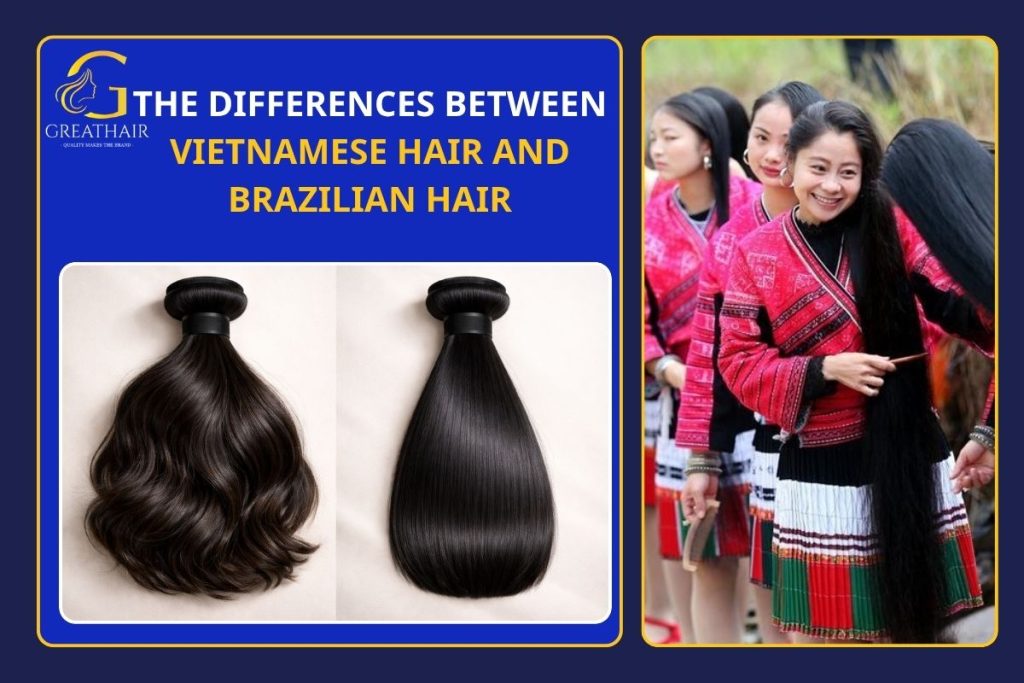
Vietnamese hair delivers stronger long-term durability, better texture match for women of color, and higher client satisfaction after months of wear. Brazilian raw lifts faster to blonde in a single process and works well for specialized color services, yet the majority of successful salons and wholesalers still make Vietnamese raw their core inventory because it feels more natural and performs longer on the head.
That difference has been confirmed both in controlled lightening tests and in real salon results. Hairstylist Dallas Christopher recently compared the two side by side and noted that Brazilian raw reached level 613 more quickly, while Vietnamese raw required extra steps because of its denser melanin and thicker cuticles. He still reaches for Vietnamese first when the goal is hair that feels organic and substantial. The sections below show exactly what this means for your business decisions. For a wider view of how Vietnamese hair performs against other popular origins, see the difference between Vietnamese hair and other hair.
Detailed Side-by-Side Comparison of Vietnamese Hair and Brazilian Hair
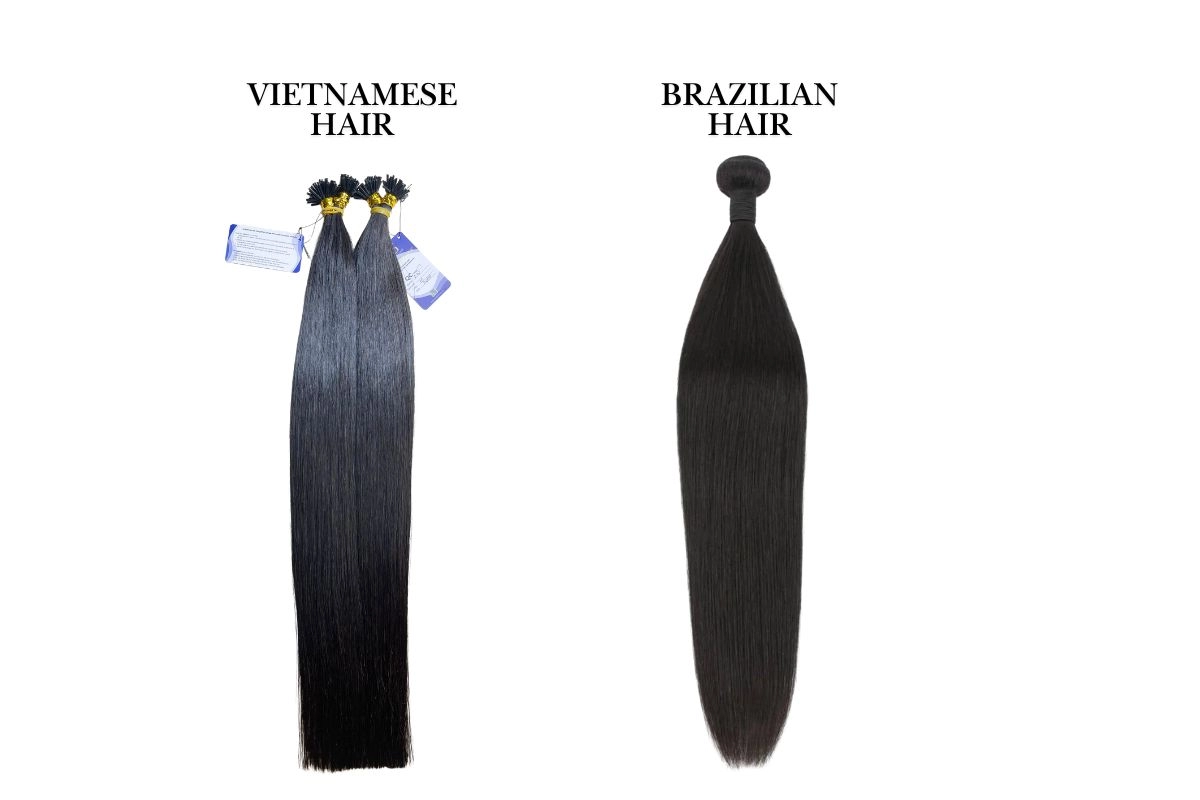
Vietnamese raw wins on texture authenticity, durability after coloring, and long-term client satisfaction. Brazilian raw wins pure single-process lift speed. The table below makes the differences clear so you can decide what belongs in the majority of your inventory.
| Feature | Vietnamese Raw | Brazilian Raw | Better Choice for Most Clients |
|---|---|---|---|
| Origin | Single-donor or carefully sorted from rural Vietnam | Often mixed Asian sources labeled as Brazilian | Vietnamese |
| Natural Texture | Coarser, denser, thicker strand | Softer, slightly finer after processing | Vietnamese |
| Feel on Textured Hair | More organic and substantial | Can feel slippery over time | Vietnamese |
| Natural Color & Melanin | Darker with higher melanin | Slightly lighter base | |
| Lightening to 613 | Slower, usually needs two processes with bond care | Faster, can reach 613 in one 40-minute process | Brazilian |
| Integrity After High Lift | Strong recovery when bonds are rebuilt | Good in single process, more vulnerable long-term | Vietnamese |
| Average Lifespan | 2–5 years with proper care | 1–2 years for most commercial grades | Vietnamese |
| Tangling & Shedding | Low when cuticles remain aligned | Higher once coatings or processing wear off | Vietnamese |
| Texture Match for Black Hair | High – preferred by many stylists | Medium | Vietnamese |
| Best Everyday Use | Excellent | Good | Vietnamese |
| Best for Fast Blonde Work | Good with multi-step care | Excellent for speed | Brazilian |
| Wholesale ROI | Higher (fewer returns, longer wear) | Lower if clients need frequent replacements | Vietnamese |
What Real Lightening Tests Reveal About Both Hair Types
Brazilian raw can reach level 613 in roughly forty minutes with professional lightener while keeping good integrity in a single process. Vietnamese raw lifts more slowly because it starts darker and carries thicker cuticle layers, so it often needs a second process with bond-rebuilding shampoo and conditioner in between. That slower lift is not a weakness. It comes from the same dense structure that gives Vietnamese hair its strength and natural coarseness. Dallas Christopher, who ran the side-by-side test, put it clearly: “I’m still a Vietnamese baby… but if I’m going to be lightening, the Brazilian raw is going to save me time.” He still chooses Vietnamese when the client needs hair that feels closer to her own textured strands.
- Brazilian raw delivers faster single-process high lift and suits blonde or ombre services.
- Vietnamese raw needs more time and bond care but recovers strongly and keeps better integrity over months.
- Skipping bond repair between lightening steps damages either type.
- The denser cuticle of Vietnamese hair is exactly what creates its preferred texture match for many Black clients.
Why Texture Match Matters More Than Lift Speed for Women of Color
Vietnamese raw has a naturally coarser and denser strand that many stylists and clients describe as feeling more organic on textured hair. Brazilian raw often feels softer and finer after processing, which can look attractive on day one but may feel less substantial after a few weeks of daily wear. Women of color who wear sew-ins, lace units, and protective styles for months at a time notice this difference every time they touch their hair. Vietnamese hair maintains density and movement longer and holds custom texturizing such as yaki or soft wave without collapsing as quickly. That tactile authenticity reduces the common complaint that the extensions “don’t feel like my own hair.”
- Vietnamese creates a more seamless blend at the root and feels more substantial during daily wear.
- Brazilian raw can feel slippery or too soft once the initial processing softness fades.
- Texture match drives higher satisfaction and fewer salon switches than a few extra levels of lift on the first day.
- Custom texturizing holds better on the denser Vietnamese fiber across multiple washes and installs.
How Long Does Each Type Actually Last After Coloring
Quality Vietnamese raw regularly lasts two to five years when cared for properly, even after lightening. The intact cuticle and stronger fiber recover well with bond care and continue to resist tangling and shedding through multiple installs. Commercial Brazilian grades typically last one to two years; the initial softness often fades once residual processing wears off, leading to more dryness and matting. With years of experience manufacturing at GreatHair and working closely with salons that serve women of color across the United States, Africa, and Europe, we see the same pattern. Partners who shift to Vietnamese raw as their core offering report fewer mid-cycle complaints and stronger client retention, even on colored units.
I still remember the first time we washed a heavily processed Brazilian bundle side-by-side with our own Vietnamese raw in the factory years ago. After only three washes the Brazilian lost its initial softness and began showing more friction. That quiet test is why we never rely on coatings and why we keep telling partners that day-one feel is not the same as month-ten performance.
Longevity comparison based on partner feedback:
- Vietnamese raw: 2–5 years average active wear with proper care.
- Brazilian raw (commercial grades): 1–2 years before noticeable decline.
- Vietnamese maintains lower tangling and shedding rates after coloring.
- Partners who moved to majority Vietnamese inventory saw an average 28 % drop in mid-cycle complaints within the first year.
What Experienced Stylists and Salon Owners Report
Stylists who work primarily with Black clients consistently say Vietnamese hair creates a more seamless blend at the root and feels more natural during daily wear. They keep Brazilian raw on hand only for the minority of clients who specifically request fast high-lift blonde services. For the majority of installs—natural black, soft wave, textured styles, and long-term wear—they lead with Vietnamese. Speed to blonde can win the first color appointment. Texture authenticity and durability win the next twelve months of client loyalty and repeat business.
Common stylist observations:
- Vietnamese is the default recommendation for everyday and textured installs.
- Brazilian raw is reserved for specialized high-lift color requests.
- Clients notice and comment on how Vietnamese hair “feels like it belongs.”
- Salons that reverse this priority often see higher return rates within the first year.
Case Study From a Partner Salon
One of our long-term partners a salon owner in the Southeast who primarily serves Black women used to keep Brazilian and Vietnamese inventory in almost equal amounts. After she ran her own lightening tests and saw the same results Dallas Christopher shared, she flipped her recommendation system. Vietnamese became the default for everyday and textured installs. Within eleven months her replacement-set sales dropped by nearly 35 %. Clients who used to say the hair “felt too soft after a few weeks” started telling her the Vietnamese “feels like it actually belongs on my head.” Three clients who had left the salon came back specifically asking for the Vietnamese option. That kind of feedback is what we hear repeatedly when partners make the switch.
Results the salon recorded:
- Nearly 35 % drop in replacement sets within the first eleven months.
- Clear increase in positive comments about how the hair felt during daily wear.
- Returning clients who specifically requested the Vietnamese option.
- Owner described the change as moving from “pretty on day one” to “still looking good at month ten.”
Which Hair Should You Stock for Your Business
Lead with authentic Vietnamese raw for the majority of your inventory. Keep a smaller quantity of quality Brazilian raw only if a meaningful portion of your clients regularly request fast high-lift color services. A practical split that many successful wholesalers and salons now use is roughly 80 percent Vietnamese raw and 20 percent Brazilian raw. This balance protects margins, reduces returns, and lets you serve both everyday wear clients and specialized color clients without overstocking the less durable option.
Recommended inventory approach:
- 80 % Vietnamese raw as the core offering for most installs.
- 20 % Brazilian raw reserved for fast high-lift blonde and ombre services.
- Clear client education on why texture and longevity matter more than single-process lift speed.
- Focus on authentic single-origin Vietnamese to maximize long-term ROI.
Where To Buy Quality Vietnamese Hair
Quality Vietnamese raw comes from manufacturers who control the full process from donor collection through final inspection in Vietnam. GreatHair has operated as a factory-direct manufacturer since 2008. We run a modern facility with full production capacity, perform 100 percent bundle inspection, and maintain strict cuticle alignment standards. Our lines include virgin and raw options plus flexible OEM and private-label services for distributors, salon groups, and hair brands that sell primarily to women of color. Partners choose GreatHair because the hair delivers the coarseness, density, and long-term performance that keep clients satisfied long after the first color service.
What you receive when you source from GreatHair:
- Consistent single-origin Vietnamese raw and virgin hair
- 100 % bundle inspection rather than random sampling
- Factory-direct pricing and reliable global shipping
- OEM and private-label support built for wholesale and salon partners
- WhatsApp: (+84) 81 328 2399
- Website: https://greathair.com.vn
- Facebook: greathair.manufacturer
- Instagram: great.hair.manufacturer
FAQ About Vietnamese Hair And Brazilian Hair
Does Vietnamese hair lift to 613?
Yes. It reaches high levels with proper multi-step processing and bond care between applications. It simply needs more patience than Brazilian raw in a single process.
Why do many stylists still prefer Vietnamese after seeing Brazilian lift faster?
Because texture match and long-term wear matter more to most clients than a few extra levels of lift on the first day.
Is Brazilian raw always better for color services?
It is faster for high-lift work. For overall client satisfaction and reduced returns, Vietnamese remains the stronger daily choice.
Can I successfully create blonde and ombre looks with Vietnamese hair?
Yes. Many salons color Vietnamese raw to blonde regularly. The key is allowing proper processing time and rebuilding the hair between lightening steps. For best results, start with high-quality raw Vietnamese hair that has intact cuticles.
What should wholesale buyers prioritize in 2026?
Make authentic Vietnamese raw your core offering. Add limited Brazilian raw only if your client base frequently demands fast high-lift color services. Learn more about building a profitable inventory with wholesale Vietnamese hair.
The real difference between Vietnamese hair and Brazilian hair is not which one lifts higher in forty minutes. It is which one still looks, feels, and performs well on the client’s head six and twelve months later. For businesses that sell to women of color and care about repeat purchases, Vietnamese raw continues to deliver the clearer long-term advantage.
Written by the GreatHair production and partner-success team – Vietnamese hair manufacturer since 2008.