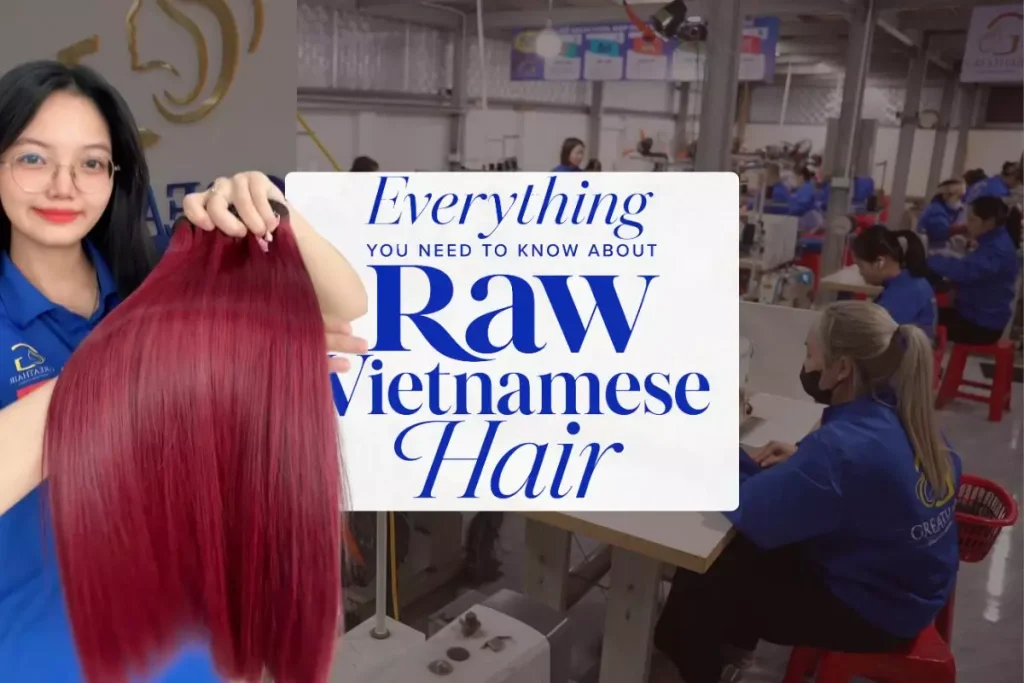
Raw Vietnamese hair refers to human hair sourced from Vietnam and supplied with its natural color and texture, without chemical alteration or manufactured wave and curl patterns. Washing, sorting and making wefts can still be part of preparing it for sale.
That description leaves several buying questions unanswered. How was the origin verified? Were the fibers altered before collection? Does “raw” describe the starting material or the finished wig? Before requesting a quote, turn the label into specific requirements you can check.
What raw means in a product specification
For a purchase that requires unprocessed hair, ask the supplier to confirm that the fibers have not been dyed, bleached, chemically straightened, permed, or steam-textured into a new pattern. Ask separately about cuticle-stripping treatments and surface coatings.
Cleaning removes dirt and buildup; sorting organizes hair for production. Neither automatically means the natural color or texture has been changed. However, “washed only” needs clarification if the supplier also applies conditioning or finishing products.
Keep related terms separate. Single donor describes hair from one person. Remy refers to cuticles oriented in the same root-to-tip direction; the cuticle is the fiber’s outer protective layer. A raw claim does not independently verify either characteristic, and aligned cuticles do not establish that hair has never been colored.
For the wider relationship between origin, processing, donor source and product format, read our Vietnamese hair buyer guide. The detailed raw versus virgin hair comparison covers that separate buying decision.
What raw Vietnamese hair can look like
Raw hair can have a straight fall or natural movement, with differences in shade and strand thickness between donors. A natural wave is not required, and a coarse or matte feel is not proof of authenticity.
Ask to see bundles intended for one wig or installation together, under consistent lighting, before washing and after air-drying. Assess whether their shade and movement work together for the finished look.
Shine and softness alone cannot establish geographic origin or processing history. Uniform bundles do not automatically prove chemical treatment either; careful selection can improve matching.
End fullness is a separate specification. A bundle may taper because it contains different strand lengths. Sorting and removing shorter strands can create fuller ends. Thin tips do not prove hair is raw, and full ends do not prove chemical processing. Ask what a drawn grade means for the specific product.
Agree on acceptable variation. It should not excuse a shipment that fails the confirmed shade, texture or fullness requirements.
Raw material and finished products need separate descriptions
Hair fibers can be sewn into wefts, tied into lace or attached to extension tips. These construction steps describe the product format. They do not, by themselves, establish whether its fibers have been colored or textured.
Further processing changes what you should expect. A wig made from raw starting hair and subsequently bleached is a colored finished product. A bundle given a manufactured wave pattern needs that treatment disclosed, even if its starting material was unprocessed.
Illustrative example: You request naturally straight raw bundles. A supplier offers a bone-straight product made from raw source hair. Ask whether its finish comes from natural selection, temporary styling or a lasting texturing process. The starting material alone cannot answer what was done to achieve the finished appearance.
Ask whether each claim applies to the incoming material, the finished fibers or the complete product. This is especially useful when a catalog groups several colors and textures under one material name.
What to ask a supplier before requesting a quote
Request written answers tied to the exact product. A general factory video cannot document every step applied to the item you will receive.
| Area to confirm | What your request should establish |
|---|---|
| Origin and traceability | Whether Vietnamese origin refers to collection or manufacturing location, and what records support the claim. |
| Processing history | Known treatment before collection and any subsequent coloring, bleaching, straightening, steam texturing, cuticle stripping or coating. |
| Donor and cuticle claims | Whether single donor is promised per bundle or per complete set, and how cuticle direction and condition are controlled. |
| Finished specifications | Product format, length and measurement method, weight basis, end fullness, color, texture and relevant lace or attachment details. |
| Sample and repeat orders | Which production specification the sample represents, acceptable variation, and how future batches will be checked against approval. |
Ask the supplier to identify what it cannot verify. An unanswered question should remain open in your purchasing decision; a reassuring product name does not resolve it.
Choose a sample that answers your buying question
Select the sample around the product you intend to order. Loose hair can help assess fiber behavior, but it cannot demonstrate weft stitching, lace knots or extension attachments. If you are buying a finished product, evaluate that construction too.
Use this sequence for the initial assessment.
- Agree on testing terms. Confirm which washing, coloring or styling tests are permitted and how those actions affect claims or returns. Resolve visible discrepancies before altering the sample.
- Record its arrival condition. Keep the product reference and written specifications. Photograph the packaging, shade, ends and construction before use.
- Check the physical specification. Measure length using the agreed method. Weigh the item on the stated basis, clarifying whether attachments or other components are included. Compare end fullness with the approved reference.
- Assess behavior under consistent conditions. Follow suitable care instructions and record the products and drying method used. Note changes in texture, detangling effort, loose hairs and breakage. Compare suppliers using the same routine rather than different treatments.
- Test the intended service separately. If coloring is essential, have a qualified colorist assess a small test section using a recorded procedure. Examine its condition after washing and drying, alongside the color result.
For a permitted wear trial, record where tangles develop, how often brushing is needed and whether strands come loose or break. Track performance beyond the first comb-through; an attractive finish can coexist with difficult maintenance.
Bleaching deserves particular care. An experimental microscopy study found substantial cuticle and internal structural damage after repeated bleaching of initially untreated hair. Being unprocessed does not make a fiber immune to damage from later treatment. pmc.ncbi.nlm.nih.gov
These checks establish how the sample performs under your conditions. They do not prove its country of origin, donor count or complete processing history. One successful sample also cannot guarantee every future batch.
Keep an approved reference and agree on acceptance criteria before ordering. For the broader testing workflow, see How to Test Hair Samples Before a Bulk Order: A Buyer Checklist.
Is raw hair right for your product line?
Raw hair is worth considering when your customers value natural texture and you can accommodate matching and variation. Decide which characteristics matter to the service you provide before paying for the label.
If customers require a specific blonde shade, a consistent manufactured curl or a finished style, assess a clearly described processed product against that requirement. Processing history and suitability should both inform the decision.
For format and customer fit, use our guide to choosing Vietnamese hair extensions for your business. Compare quotes only after aligning the product specifications.
FAQs About Raw Vietnamese hair.
Does raw Vietnamese hair always come from one donor?
Do not assume so. Ask whether single donor is explicitly included in the specification and whether it applies to each bundle or the whole set. Raw and single donor describe different claims.
Does a 1B color code prove the hair is undyed?
No. A shade code describes the requested appearance. Ask whether that shade is naturally occurring, selected through matching or produced through coloring.
Can every raw bundle be bleached to platinum?
No. The label cannot guarantee a particular lightening result. Confirm the intended target with the supplier and have a colorist test the actual sample before planning the service.
Will washing prove whether hair is raw?
Washing helps assess texture and manageability under the conditions used. It cannot independently establish every earlier treatment or prove where the hair was collected.
How long should raw Vietnamese hair last?
There is no reliable lifespan you can assign from the label alone. Starting condition, construction, installation, wear, maintenance and later processing all affect usable life. Request product-specific care guidance and warranty terms separately.
Choose your specifications and request a sample
Send GreatHair your intended product format, length, weight or density, color, texture and planned coloring or styling service. Contact GreatHair to discuss the specification and request a suitable sample. Ask for the material description, processing details and sample terms in writing before confirming your order.