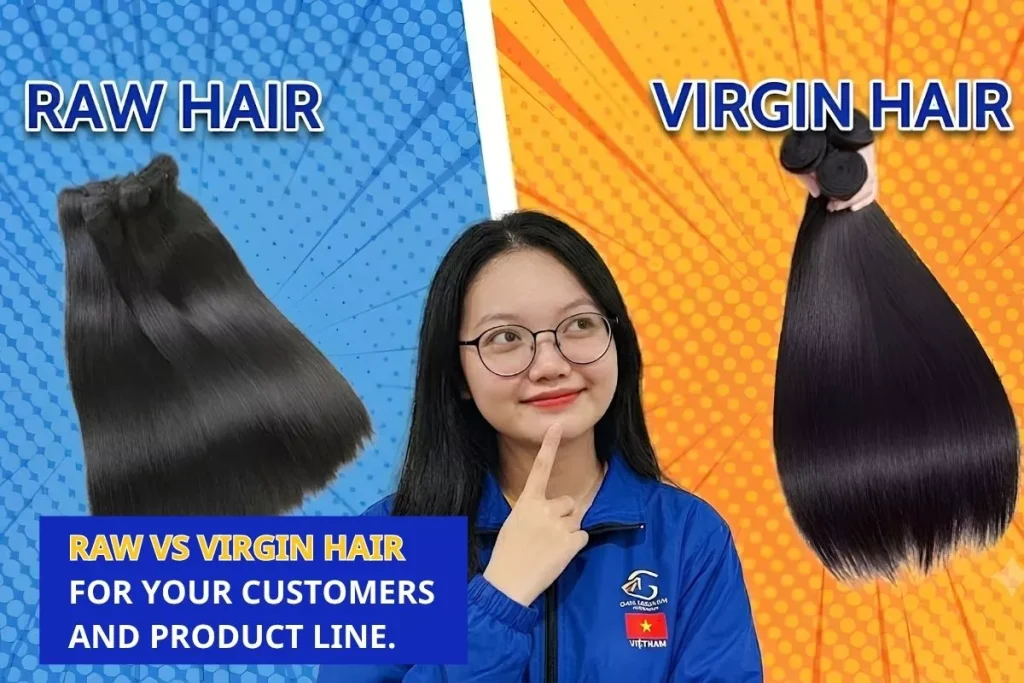
When comparing raw vs virgin hair, start with the style your customer wants to wear. Verified raw hair can suit a collection built around natural texture and carefully selected donor hair. Virgin hair can suit a collection that prioritizes coordinated styles, accessible pricing and repeat orders. Neither label, by itself, tells you how well a finished wig or extension will perform.
The useful question is whether the hair delivers the right feel, finish and care commitment at a price your customer understands. Here is how to make that choice without paying for promises the product cannot support.
What the raw and virgin labels actually tell you
Raw hair generally describes human hair that retains its natural color and texture, without dyeing, bleaching, chemical texture alteration or steam shaping. Cleaning, sorting and sewing it into a weft are preparation steps; they do not necessarily change the hair’s natural pattern.
Virgin hair, in its strict sense, means hair that has not been chemically colored, bleached, relaxed or permed. Some suppliers also use the term for chemically untreated hair shaped with steam. Others use it more narrowly, so ask exactly what preparation the finished product has received.
The terms can overlap. Donor count is another question: “raw” alone does not establish that every strand came from one person, and “virgin” does not automatically mean mixed donor. Confirm single donor claims separately.
| Comparison point | Raw hair in its natural state | Hair sold as virgin |
|---|---|---|
| Color and texture | Natural donor shade and pattern | Chemically untreated in strict usage; ask whether texture was steam shaped |
| Donor sourcing | May be single donor or selected donors | May be single donor or mixed donor |
| Consistency | Natural differences can appear between bundles | Sorting and texture preparation can create a more coordinated collection |
| Coloring potential | Must be confirmed on the intended material | Must be confirmed on the intended material |
| Price | Often higher for carefully selected donor hair | Can offer more price and specification options |
| Care | Depends on texture, construction and subsequent treatment | Depends on texture, construction and subsequent treatment |
Remy describes root-to-tip cuticle alignment, not a separate promise about chemical history. The cuticle is the hair’s outer protective layer. Ask about both its preservation and direction. For the wider terminology, see our guide to Vietnamese human hair.
Natural variation can be beautiful without being a defect
A soft wave, a slightly warmer brown or a finer strand can give donor hair its character. Across several bundles, those differences may need matching before you create one finished hairstyle. Single donor sourcing can reduce one source of variation, but it cannot guarantee identical strands or consistent stock across future orders.
A coordinated body-wave collection has a different requirement. Your customer expects the advertised wave, shade and fullness to look similar each time they buy. That depends on selection and production controls, not simply whether the invoice says raw or virgin.
Wash and dry comparable samples using the same routine. Look at their unstylized texture as well as the polished finish. Natural variation is acceptable only within the expectations you agree with your supplier and communicate to your customer.

Both materials can become beautiful products
Raw and virgin source hair can be used for bundles, wigs, closures and extensions. The finished result also depends on weft construction, lace work, density and attachment quality.
Separate the starting material from the finished treatment. Hair sourced as raw may later be colored or steam shaped. A blonde wig made from raw donor hair has been processed to become blonde; describing it as completely unprocessed would mislead your buyer.
For custom color, the raw label is not a promise of platinum. Starting shade, previous treatment and fiber condition all matter. GreatHair’s standard natural-color 1B material should not be assumed suitable for blonde lifting. State your intended shade before choosing material, and distinguish a finished blonde product from hair your own colorist plans to lighten.
Have a colorist assess a representative sample and follow the color manufacturer’s directions. Wella recommends strand testing to establish timing and color results. Wella Judge the hair’s condition after rinsing and drying, too: excessive bleaching can damage the cuticle and internal structure, even when the color looks attractive.

Compare prices for the same finished specification
Raw donor hair often costs more because sourcing, selection and matching can add work. That does not make every raw product better value than every virgin product.
Compare the same length, weight, color, texture and end fullness. Double drawn describes a selection with more strands close to the stated length, creating fuller ends; confirm the supplier’s actual standard. For wigs, also match lace area, density and cap construction. A fuller virgin bundle and a lighter raw bundle are different offers.
Then include the work needed to make each product saleable. Extra matching, coloring or styling can change your margin. Pay for a difference your customer can see or benefit from, and request a dated quotation for the exact specification.
Choose for the customer you actually serve
For a collection centered on natural texture
Consider verified raw hair when your customers value natural movement, donor selection and a finish they can style themselves. Approve how much shade and texture variation you will accept. A higher price needs a clear explanation of the material and selection behind it.
For everyday wigs and coordinated styles
A well-specified virgin collection can be a practical starting point when buyers want a familiar straight or wave pattern at an accessible price. If the texture is factory shaped, disclose that preparation. Check how it behaves after washing, since a styled product photo does not show the whole care routine.
For salons offering custom color
Choose around the intended shade and a successful sample assessment. A raw designation alone cannot approve a blonde service. Ask about the material’s processing history and whether the bundle and closure use comparable hair.
For a new brand building its first range
Begin with the styles your customers already request and a small range you can explain confidently. You can add a raw donor collection when there is a clear demand for its characteristics. Our guide to choosing hair products for your business explores the wider assortment decision.
Care should follow the finished hair
Neither category removes the need for maintenance. A curly wig, colored extension and natural straight bundle have different routines, regardless of the original material label.
Condition after washing, detangle gently from the ends and limit excessive heat. These principles also appear in American Academy of Dermatology hair-care guidance. For extensions, follow the attachment system’s instructions on conditioner and oils around bonds or tapes.
Avoid selling a fixed lifespan based only on raw or virgin. Wear frequency, treatment, friction and construction affect how long the product remains usable. Give customers an achievable care routine instead of a blanket multi-year promise.
Explain the product honestly and specifically
Replace broad claims with descriptions your customer can picture. “Natural-color donor hair with a soft natural wave” explains more than “the highest grade available.” For a prepared collection, “human hair shaped into body wave, with care instructions to maintain the finish” tells the buyer what they are receiving.
Only add single donor, uncolored or cuticle-preserved claims when supported for that product. If raw source hair has been dyed, say so. Keep product photos, labels and care advice consistent with the approved sample. That clarity helps customers choose and gives your team a better basis for answering questions after purchase.
FAQs About Raw vs Virgin Hair.
Is raw hair always single donor?
No. Confirm donor sourcing separately. A raw label alone does not establish single donor traceability.
Can virgin hair be curly?
Yes. It may be naturally curly or steam shaped, depending on the supplier’s terminology. Ask which applies.
Does a silky feel prove that hair is virgin?
No. Touch cannot establish chemical history. Compare documented specifications and assess a washed sample.
Can raw bundles be paired with a virgin closure?
Potentially, if shade, strand feel, texture and intended coloring behavior match. Assess the combination before offering it as a set.
Should a new hair brand sell both categories?
Only if each serves a clear customer need. A focused, well-described range can be easier to support than two loosely defined quality tiers.
Choose your specification before requesting a sample
Send GreatHair your product type, length, weight or density, desired shade, texture and intended use. Include whether you need natural donor texture, a prepared style or material for professional coloring.
Contact GreatHair to discuss a quotation and representative sample. Compare the actual finish and care requirements, then choose the raw or virgin option that fits the experience you want your customers to have.