


There are no products in the cart
Oct 25, 2025
Post by Alice Bonita
Ethically sourced hair extensions matter for two reasons at once: they protect the people behind the product, and they usually lead to a more trustworthy supply chain for the buyer. In an industry that beauty reporting and academic research have repeatedly described as opaque, underregulated, and vulnerable to exploitation, “ethical” cannot be a vague brand promise. It has to mean traceability, fair dealing, and lawful working conditions.
For US and EU buyers, that standard is becoming more important, not less. OECD guidance frames due diligence as a practical business responsibility, and the EU’s Corporate Sustainability Due Diligence framework is pushing companies in scope to identify and address human-rights and environmental risks across value chains.
That is also why Vietnamese hair sources get so much attention. Vietnam already exports hair products at scale, and reporting from Vietnam shows that direct, transparent buying models can give women meaningfully better payouts than traditional brokers. Combined with a labour framework the ILO says is better aligned with international standards, human hair from Vietnam can be a strong option when the vendor can prove how the hair is collected and processed.
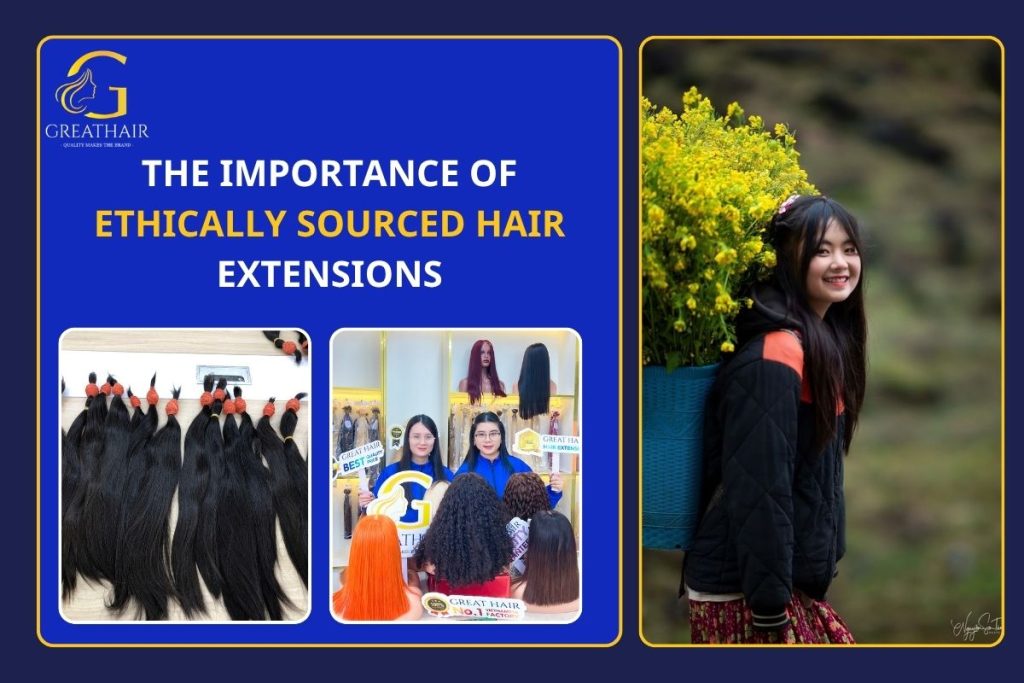
Ethically sourced hair extensions are not simply “real human hair” or “premium hair.” In practice, ethical sourcing means the material is obtained and processed through a supply chain that treats people fairly, reduces abuse risk, and gives the buyer enough visibility to verify what they are being told. In human hair, that matters because the category has long been described as secretive and difficult to trace.
A credible ethical standard for hair extensions usually includes four basics:
If one of those pieces is missing, the phrase “ethically sourced hair extensions” starts to lose meaning very quickly.
Vietnam is not automatically the ethical answer, but it is one of the more practical origins to evaluate when you want better traceability. The country already has an established hair-products export base, and its updated labour framework includes stronger worker protections, clearer rules around employment, and closer alignment with international labour standards, according to ILO materials.
The strongest case for Vietnamese Hair Sources is supply-chain structure. In one reported Vietnam-based model, a buyer publicly allowed third-party scrutiny of its sourcing route, purchased directly from women, and paid far above what local brokers had previously offered. That does not prove every Vietnam hair vendor works this way, but it shows why Human hair from Vietnam can be easier to trust when the supplier has a direct-collection model instead of a vague, multi-layer broker chain.
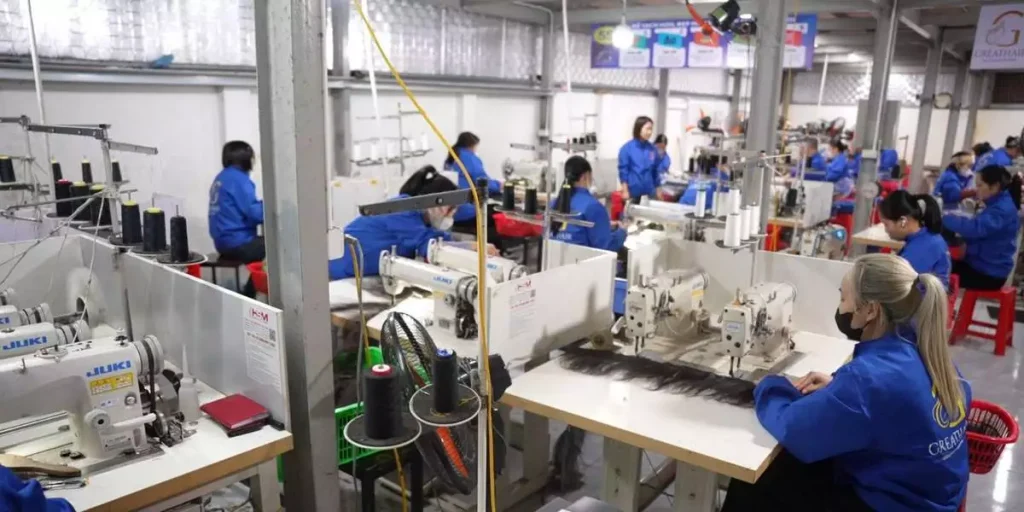
This matters for quality too, though quality should never be confused with ethics. Many buyers looking for Raw Vietnamese hair suppliers want hair that is minimally processed, consistent, and still has intact cuticle alignment. Those goals are easier to evaluate when the chain is shorter and the factory can explain exactly when the hair was collected, sorted, cleaned, and manufactured. In other words, Vietnam stands out less because of a marketing myth and more because transparent sourcing is more feasible when fewer hands touch the hair before export.
For US and EU buyers, that combination is attractive: a known export origin, a legal framework that gives you real audit points, and the possibility of buying from suppliers who can show direct sourcing rather than hiding behind generic labels like “virgin” or “raw.”
The right way to vet a supplier is to look for proof, not polished branding. Responsible sourcing guidance from the OECD and the EU’s due-diligence direction both point the same way: buyers should identify risk, ask for evidence, and verify the chain rather than relying on supplier claims alone.
When you speak with Raw Vietnamese hair suppliers, ask these questions first:
Then check whether the answers stay consistent across WhatsApp, email, invoices, and samples. Ethical suppliers tend to be boringly consistent. Unreliable ones often change the story depending on what the buyer wants to hear.
>> Read More: Raw Vietnamese Hair Quality, Sourcing & Wholesale Guide
If you are buying ethically sourced hair extensions for a salon, brand, or wholesale operation, you should expect documentation and transparency as part of the deal, not as an extra favor. That expectation is increasingly aligned with broader responsible-sourcing practice, especially for companies selling into markets where supply-chain scrutiny is rising.
A trustworthy Vietnam hair vendor should be able to tell you what the product is in plain language. Is it single-donor or mixed-donor? Raw or processed? Natural color or color-treated? Bulk hair, weft hair, tape-ins, tips, or wigs? Those details are not minor. They determine whether you are buying the same product category you think you are buying.
You should also expect realistic limits. For example, truly raw, highly uniform long hair is naturally more constrained in volume than heavily processed mass-market hair. If a seller promises unlimited stock, ultra-low pricing, exact texture matching, and perfect cuticle alignment all at once, that is usually a sign to slow down and verify more carefully.
For EU-facing businesses, the practical lesson is simple: buy as if you may need to explain your sourcing later. For US buyers, the same discipline still pays off because it lowers refund risk, quality disputes, and reputational damage. Ethical sourcing is not just a values issue. It is also a procurement discipline.
The biggest mistake is assuming origin alone guarantees ethics. Vietnam can be a very good sourcing option, but only when the supplier can show how the hair moved from donor to finished product.
The safer approach is to verify the chain, not just admire the final bundle.
Is Vietnamese hair always ethically sourced?
No. Vietnam is a promising origin, but ethical sourcing depends on the supplier’s actual collection, payment, labour, and traceability practices, not the country name alone.
Why do buyers often prefer Human hair from Vietnam?
Because Vietnam combines established export capacity with sourcing models that can be more transparent and easier to audit when suppliers buy directly and process in-house.
What should Raw Vietnamese hair suppliers be able to prove?
They should be able to explain origin, donor-payment method, processing steps, in-house manufacturing scope, and batch-level consistency.
Are EU buyers under more pressure to verify sourcing now?
Yes. The EU’s sustainability due-diligence framework is designed to push companies in scope to identify and address adverse impacts across value chains.
Does ethical sourcing mean the hair will always be better quality?
Not automatically. Ethics and quality are related, but they are not identical. Ethical sourcing reduces opacity; quality still depends on hair type, processing, storage, and manufacturing accuracy.
Is direct-from-donor sourcing better than buying through brokers?
Usually it is easier to audit and easier to explain, which is why many buyers prefer it. But it still needs proof, clear payment practices, and consistent records.
What is the fastest way to assess a new Vietnam hair vendor?
Ask for a current factory video, a sample tied to a specific batch, a clear explanation of origin and processing, and documents that match the story they tell in chat.
Ethically sourced hair extensions are important because the hair industry has real transparency and exploitation risks, and buyers in the US and EU are under growing pressure to know more about what they sell. Vietnam stands out not because every supplier is ethical by default, but because Vietnamese Hair Sources can offer a more traceable, more verifiable route when the vendor has direct sourcing, clear documentation, and lawful production practices. For buyers who want both accountability and product confidence, that is the real value of choosing the right source in Vietnam.
If you want beautiful, soft hair and a reliable supplier, GreatHair is the place to start.

We Will Contact You Shortly


Address: 8 Ngo 20/45 D. Phu Minh, Minh Khai, Bac Tu Liem, Ha Noi, Viet Nam
Phone: (+84)813282399

There are no products in the cart