
A human hair wig can be curled, smoothed, or worn up, but a convincing finish starts before you pick up a hot tool. Detangle gently, set the part and direction, dry the wig completely, then style in small sections with the lowest effective heat and a suitable protectant. Let curls cool before separating them. The details that matter most are cap construction, density, and how often you restyle: a simple style that suits the unit usually looks more natural and lasts longer than repeatedly forcing it into a new shape.
What You Need Before Styling ?
- A few reliable tools and a stable stand are enough. They help you control tension, heat, and direction.
- A wide-tooth comb or flexible paddle brush for gentle detangling.
- A wig stand or block head, a clamp, and sectioning clips.
- A blow dryer with a concentrator nozzle and a temperature-controlled flat iron or curling iron.
- A heat protectant labeled for human hair and a light finishing spray.
Human hair is real hair, but a wig is no longer growing from a scalp. It receives no conditioning from scalp oils, and repeated heat or friction can leave the lengths dry and rough. The cap also matters: lace and monofilament can tear if pierced, stretched, or pressed with a hot tool. For more on how construction affects styling freedom, see our guide to different wig types.
How to Style a Human Hair Wig Step by Step
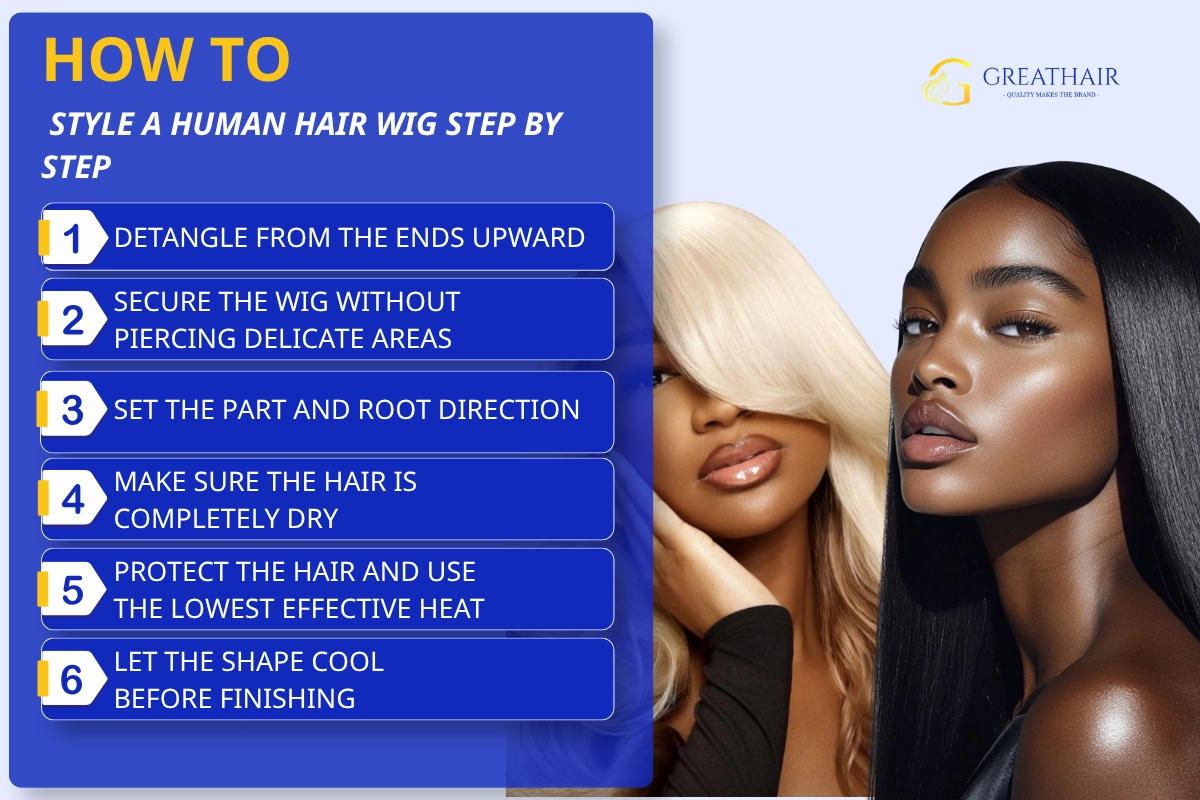
A polished result comes from a consistent order: detangle, secure, set the part, dry completely, then use heat in small sections.
1. Detangle from the ends upward
Start at the tips and work upward, holding the hair above the section so tension does not pull on the knots. Remove snags before using a brush or hot tool. If the wig is wet, use the comb and handling method recommended by its maker.
2. Secure the wig without piercing delicate areas
Place the wig on a stable head and fasten it through sturdy cap areas only. Never push T-pins through lace, monofilament, or hand-tied sections. Avoid stretching the damp cap, which can affect fit.
3. Set the part and root direction
If the cap allows a movable part, lightly dampen the roots, comb them in the desired direction, and use gentle dryer airflow to set them. Follow a fixed part instead of forcing it across the cap.
4. Make sure the hair is completely dry
Air-drying overnight reduces dryer time; a controlled blow-dry can smooth roots and shape the hair. Follow the maker’s instructions. Before using a flat iron or curling iron, make sure the hair is completely dry.
5. Protect the hair and use the lowest effective heat
Apply heat protectant as directed and work in small sections. Keep the tool moving and avoid repeat passes. There is no universal wig temperature; color, processing, texture, and tool accuracy all matter.The American Academy of Dermatology recommends low or medium heat and limited exposure in general hair-styling guidance.
6. Let the shape cool before finishing
Let curls cool before separating them. Pin them briefly for definition or let them fall for softer movement. Loosen waves with your fingers, then finish with a light spray and a little serum on the ends.
Easy Styles That Work on Human Hair Wigs
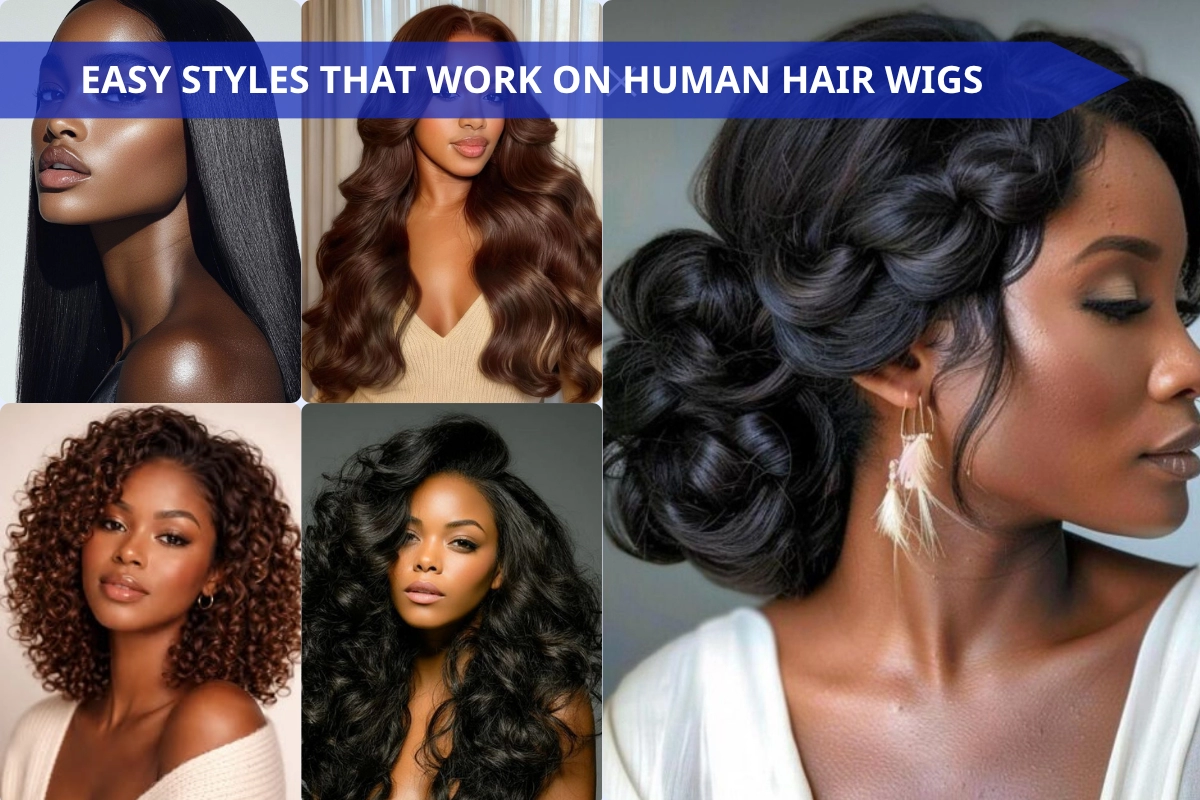
Choose a look that suits the wig’s texture, length, density, and cap design. These simple styles do not require rebuilding the whole wig.
Sleek and straight
Smooth small sections, starting about an inch below the roots to avoid pressing against the cap. Keep the ends straight or turn them slightly inward. Check the face-framing pieces for an even finish.
Soft, relaxed waves
Create loose bends, alternating curl direction through the back for a relaxed finish. Leave the last inch straighter for an undone look. Separate cooled waves with your fingers.
Defined curls
For a polished frame, curl the front sections away from your face and keep their direction consistent. Use smaller sections for definition, let them cool, then finish with a light hold spray.
A side part or swept fringe
Make the part before drying so roots lie in the right direction. Shape fringe with a round brush or roller and controlled heat. If you want bangs, wear the wig and ask a stylist to cut it; a mannequin can distort the final length.
A low ponytail or half-up style
Check the cap before pulling hair away from the face. Some lace fronts reveal their construction when tightly pulled back, while other designs allow more updo freedom. Keep the tie loose and choose a low or half-up style if the hairline is not made to be exposed.
Small Details That Make the Style Look More Natural
A natural finish comes from matching the style to the wig, not adding more heat. From our experience in wig manufacturing, style problems often come down to section size, incomplete drying, or a cap that does not support the part or updo someone wants.
- Choose the silhouette first. If a wig feels too full, try softer waves or a different part instead of repeatedly straightening it. Density and length change the volume.
- Reduce nape friction. Long hair can tangle against rough collars and textured fabrics; smooth clothing and gentle detangling help preserve the finish.
- Refresh instead of resetting. Touch up visible pieces between washes, then store the wig on a stand or lay it flat to prevent kinks.
- Keep products light. Excess oil, mousse, or spray can flatten movement and cause buildup.
A Wearer’s Case Study
One wearer with naturally fine hair said a full wig initially felt unfamiliar when straight. She settled on loose curls as her signature: air-drying overnight, working in sections, briefly blow-drying on low to tame flyaways, curling away from her face, then loosening the cooled curls with her fingers. Instead of rebuilding the style every morning, she refreshed it between washes. Her routine is not a prescription; it shows that a comfortable, repeatable silhouette may work better than chasing a look that feels unlike you.
Where to Buy Quality Vietnamese Human Hair Wigs for Your Business
For salons, resellers, and private-label brands, a wig’s styling performance depends on consistent hair, clear density specifications, and cap construction that matches the styles customers want. GreatHair manufactures Vietnamese human hair wigs for wholesale buyers in a range of textures, colors, and constructions. Explore the human hair wig collection and contact the wholesale team for product specifications, sample options, or an OEM quote for your market.

FAQ About Style A Human Hair Wig
Can you use a flat iron on a human hair wig?
Yes, if the wig is human hair and its care instructions allow heat. Work on fully dry hair, use heat protectant, and start low.
What temperature should I use on a human hair wig?
There is no universal setting. Follow the maker’s limit and begin low; 350°F is one brand’s maximum, not a general standard.
Can you style a wig while it is wet?
You can guide damp roots if the cap allows it, but use a flat iron or curling iron only after the hair is completely dry.
How do you make curls last longer?
Curl small sections and let them cool fully. Pin them for more definition, use light spray, and do not brush them while warm.
Can every human hair wig be worn in a high ponytail?
No. Cap and hairline construction determine how much of the wig can be exposed. Check the maker’s guidance before choosing a high ponytail.