



There are no products in the cart
Sep 14, 2025
Post by Alice Bonita
Super double drawn Vietnamese hair is Vietnamese human hair that has been sorted so the bundle stays much fuller from top to bottom than single drawn hair. In hair-extension industry usage, double drawn means shorter hairs have been removed to reduce taper at the ends, while super double drawn usually refers to an even fuller bundle with a higher same-length ratio. Exact percentages are not universal, so buyers should verify density, end thickness, and bundle weight instead of trusting the label alone.
For salons and wholesale buyers, that distinction matters most in longer lengths and premium installs. If your client wants thick ends, blunt finishes, or a very polished luxury look, super double drawn Vietnamese hair usually makes more sense than standard single drawn hair; if they want a softer, more natural taper or a lower-ticket service, it may be more hair than they actually need.
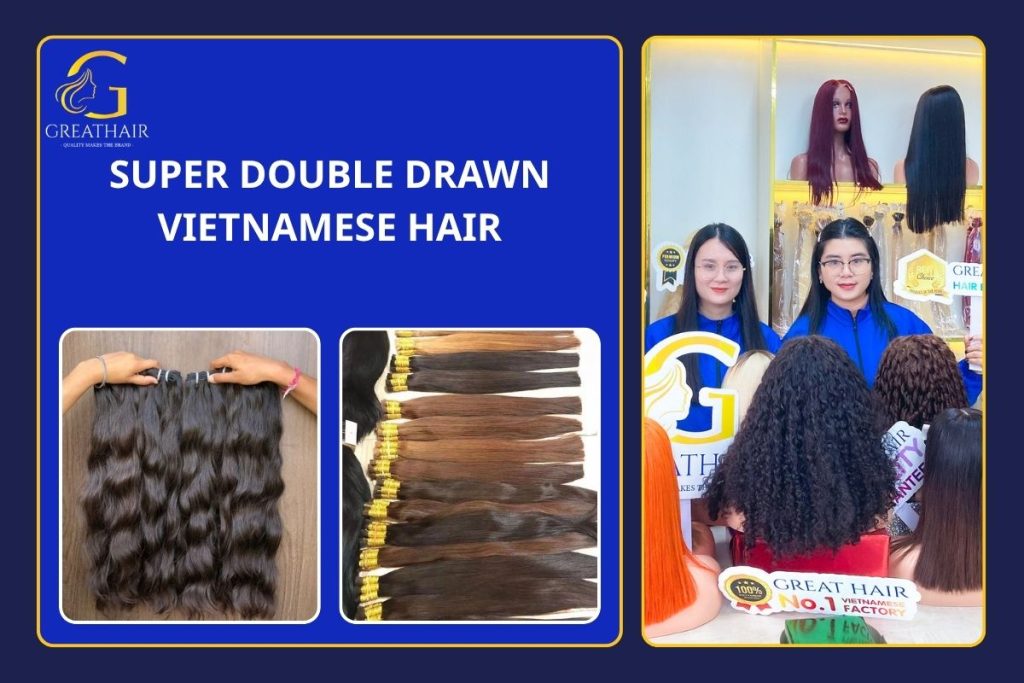
The short answer is that “double drawn” describes fullness, not origin. In industry guides, double drawn hair is made by removing many of the shorter strands so the bundle looks thicker at the ends, while super double drawn is positioned as an even fuller version. Supplier education pages commonly place standard double drawn around a mid-to-high fullness ratio and super double drawn above that, but the numbers vary by brand, which is why buyers should treat the term as a starting point, not a guarantee.
That also means double drawn Vietnamese hair should not be confused with Remy hair, virgin hair, or raw hair. These terms describe different parts of quality: double drawn refers to density distribution from root to tip, while Remy refers to cuticle alignment in the same direction, which helps reduce tangling and keeps the hair smoother over time.
A simple way to separate the terms is this:
For anyone sourcing vietnamese super double drawn hair, the safest mindset is to evaluate both fullness and hair integrity, not one without the other.
>>Read More: Vietnamese Hair Is Offered As Single Drawn And Double Drawn
The main reason is visual impact. Double drawn Vietnamese hair gives a denser finish at the bottom, which makes installs look more expensive, more intentional, and less wispy, especially in long lengths. That is why premium brands position double drawn collections as fuller, thicker, and better suited to clients who want a glam or high-density result.
Vietnamese hair is often marketed around natural softness, full-bodied texture, and straight to slightly wavy patterns, which is why many salons use it for sleek installs, polished wefts, and extensions that need a clean fall pattern. In supplier literature, Vietnamese hair grades commonly include single drawn, double drawn, and super double drawn, making it a familiar sourcing category for both salons and wholesale resellers.
This type of hair usually makes the most sense when you are selling one of these outcomes:
In other words, super double drawn Vietnamese hair is less about hype and more about matching the right density profile to the result your client is paying for.

The biggest difference is not whether the hair is “real,” but how the bundle wears visually from mid-length to ends. Single drawn hair contains mixed lengths, so it looks more natural and layered, while double drawn hair looks thicker and more uniform through the bottom half. For buyers, that changes both pricing and client expectations.
If you are choosing between vietnamese double drawn hair and single drawn hair, compare them on outcome rather than labels alone:
There is also a commercial reason behind the upgrade. Multiple industry sources note that double drawn hair costs more because it requires more hair selection and additional processing or sorting to create that root-to-tip fullness.
The best way to buy double drawn Vietnamese hair is to verify the construction, not just the wording. A good supplier should be able to explain how the hair is graded, whether the cuticles are aligned, how processed the hair is, and what quality-control steps are in place. Brands that emphasize traceability, responsible sourcing, or in-house quality control make those details much easier to validate.
Before placing a larger order, use a practical buying checklist:
This process matters because a full-looking top section can hide thin ends, and a “super” label does not tell you enough on its own. The buyers who make better sourcing decisions are the ones who inspect density, processing level, and cuticle condition together.
It is worth the premium when end density is the product, not just a nice extra. Longer installs, blunt-cut transformations, luxury wefts, and premium salon packages benefit most because the client can actually see the fuller finish they are paying for. That is also why some brands argue that fuller double drawn hair may deliver better value in the long run for volume-driven results, even if the upfront cost is higher.
It is usually less worth it when the style is meant to look lightly layered, budget-sensitive, or very natural at the perimeter. In those cases, single drawn or standard double drawn hair may be enough, especially if the client prioritizes price over maximum fullness.
A good rule is to match the hair grade to the finished look:
That is the real buying logic behind super double drawn Vietnamese hair: you pay more when the service depends on visible fullness all the way down.
Most sourcing mistakes happen because buyers treat one label as proof of total quality. In reality, density, cuticle alignment, processing level, and supplier consistency all matter together.
Avoiding these mistakes makes sourcing much simpler, because you stop buying labels and start buying verified performance.
Is double drawn Vietnamese hair the same as super double drawn?
No. Double drawn Vietnamese hair is already fuller than single drawn, but super double drawn is marketed as an even denser grade with a higher same-length ratio. The exact percentage varies by supplier, so ask for the seller’s grading standard before you order.
Is double drawn Vietnamese hair always Remy hair?
No. Double drawn describes fullness, while Remy describes cuticle alignment. A bundle can be marketed as double drawn, but you still need to confirm whether the cuticles are aligned and how processed the hair is.
Why is super double drawn Vietnamese hair more expensive?
Because creating a fuller bundle requires more sorting, more selection, and often more raw hair input. Industry sources consistently position double drawn and super double drawn lines as premium because of the extra work needed to keep the hair thick from root to tip.
Is super double drawn Vietnamese hair better for salons?
It is better when the salon sells high-density, premium-looking installs, especially in longer lengths. It is not automatically better for every service; for softer or lower-budget installs, standard double drawn or single drawn may fit the client better.
Do you need fewer bundles with double drawn Vietnamese hair?
Sometimes, yes, because fuller ends can create more visual density per bundle. But bundle count still depends on grams, length, installation method, and the client’s target look, so do not base purchasing on the label alone.
How can I tell whether a supplier’s super double drawn hair is really premium?
Ask for the grading definition, confirm whether the hair is Remy, inspect the bottom third of the bundle, verify weight and processing, and place a sample order first. Premium fullness without good cuticle alignment or consistent QC is not enough for long-term salon performance.
How should clients care for double drawn Vietnamese hair?
Care depends on the extension method, but reputable aftercare guides consistently recommend gentle handling, sulfate-free products, limited overwashing, daily detangling, and heat protection. Good aftercare protects the value of premium human hair, whether it is double drawn or super double drawn.
Double drawn Vietnamese hair is best understood as a fullness standard, not a complete quality verdict. Super double drawn Vietnamese hair is worth considering when your goal is dense, polished, root-to-tip volume, but smart buyers still need to verify Remy status, processing level, weight, and end thickness before ordering. For salons and wholesale buyers, the best decision is the one that matches the client’s finish, budget, and service level rather than the boldest label on the product page.
Ready to give your wig the royal treatment? Contact us via:

We Will Contact You Shortly



Address: 8 Ngo 20/45 D. Phu Minh, Minh Khai, Bac Tu Liem, Ha Noi, Viet Nam
Phone: (+84)813282399

There are no products in the cart