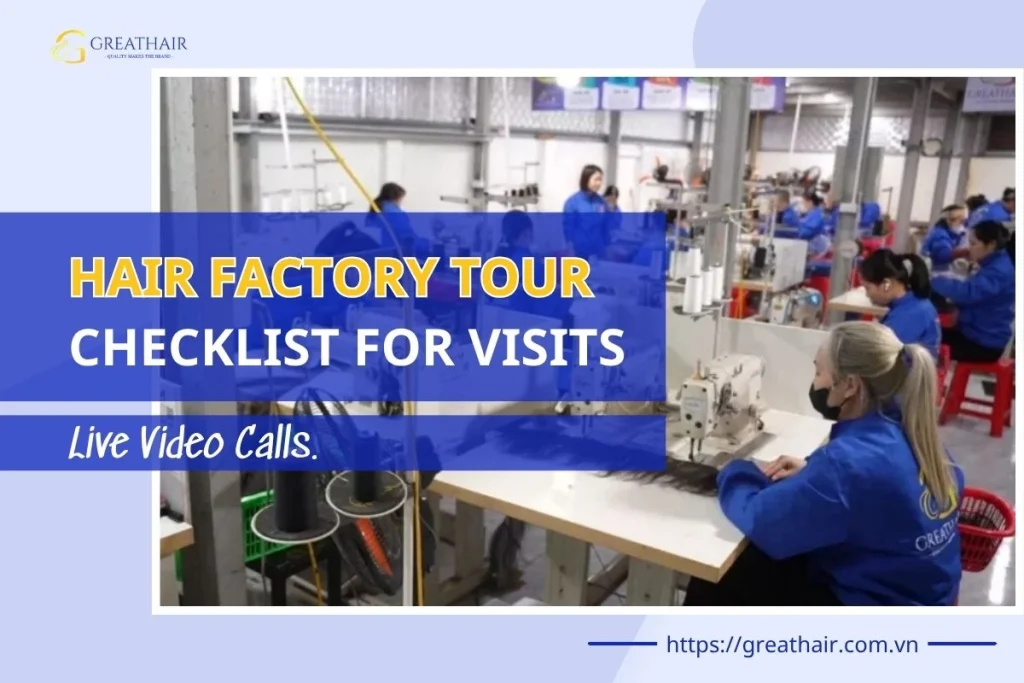
Before buying wholesale hair, use a hair factory tour checklist to examine the facility, follow production, check randomly selected items, and clarify quality control and delivery capacity. Leave knowing what the supplier demonstrated and what still needs testing.
At GreatHair, we recommend focusing on the hair you actually plan to sell. For a salon, that might mean tape attachments and shade consistency. For a wig brand, lace work, cap construction and fullness deserve closer attention.
Plan a tour around your order
Share your product type, length, color, texture, fullness grade and estimated quantity. Include the SKU, or product reference code, if available.
Agree on the date, time zone, areas to visit and operations that will be running. Ask for someone from production or quality control to join technical discussions. Confirm whether photographs, recordings and product demonstrations are permitted.
Have your specifications ready, along with a ruler, scale and note-taking sheet. For video calls, ask the host to prepare the measuring equipment.
Still building your shortlist? Our guide to choosing wholesale hair vendors covers that earlier decision.
Check the company and working environment
Look for company signage at the entrance and inside the building. Compare the name with your quotation, and ask how the site relates to the business taking your order. Branding alone cannot establish ownership.
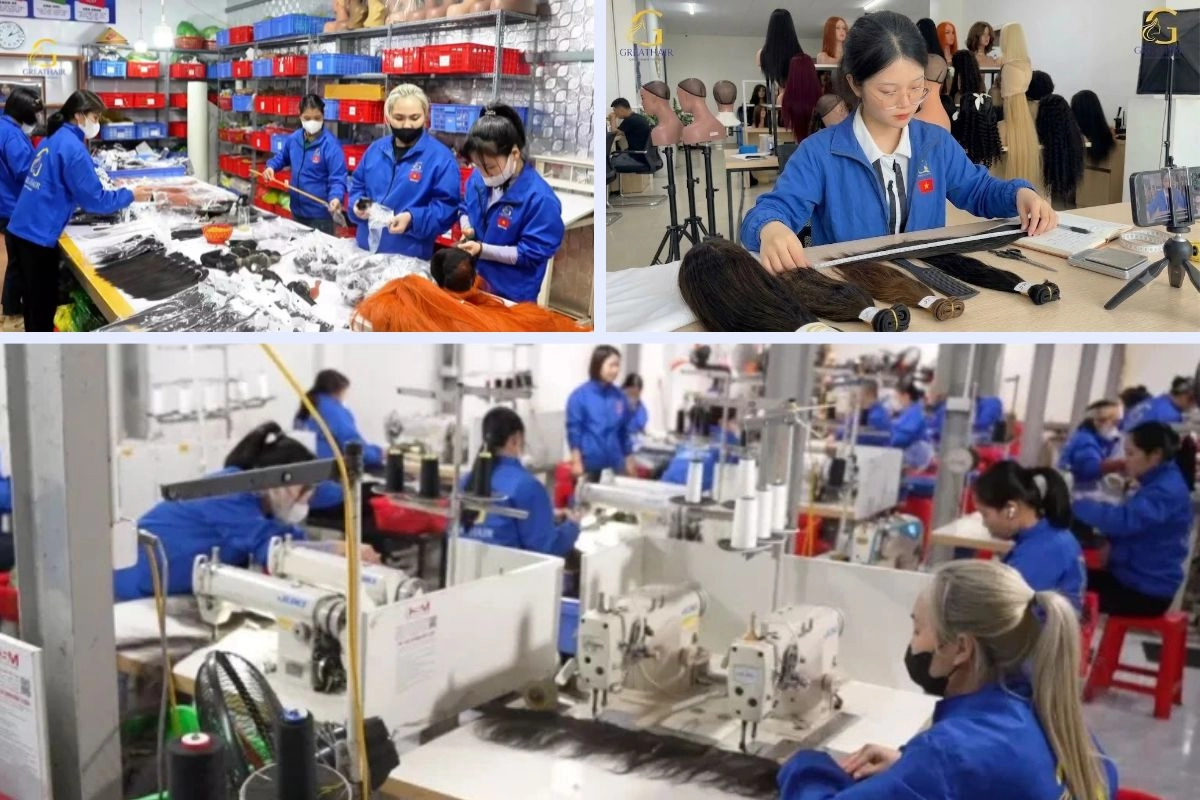
Observe the workshop size and roughly count the people working in the areas shown. Ask which shift you are seeing and whether the quoted workforce includes other locations. A small workshop can be a genuine manufacturer; the question is whether its capabilities match its claims and your order.
Look for organized workstations, clear production areas, suitable ventilation and clean handling surfaces. Check for separate, labeled storage for incoming hair and finished products, protected from moisture, dirt and pests.
A trader may also have factory access. Confirm who operates the facility and controls production.
Follow the hair through the relevant production stages
Start with incoming hair before finishing. Ask to see opened bundles and how staff inspect for dirt, debris, suspected lice or eggs, and damaged strands. A video view cannot rule out contamination. Gray hairs are natural variation; clarify the amount permitted in your specification and how they are sorted.
Watch workers separate lengths and remove unwanted short or damaged strands. Ask how the resulting fullness is matched to the quoted grade.
Examine weft construction and lace work
For machine wefts, inspect the stitching rows, seam consistency and any sealing adhesive used to limit shedding. Double stitching or visible glue alone does not establish quality. Hand-tied and other weft designs need checks appropriate to their construction.
For closures, frontals and wigs, watch lace ventilation the hand-knotting of hair into lace. Look at knot size, spacing, attachment security and neatness. Inspect the hairline separately from the denser areas behind it.
For tape-ins or tips, request a close view of attachment dimensions and consistency.
Ask how color and texture are created
Find out whether waves and curls are steam-set, chemically processed or produced through a combination of treatments. Ask about previous bleaching, coloring and finishing products.
We recommend judging the finished result after appropriate washing and styling. A “steam processed” description alone cannot establish durability or make every product suitable for further coloring.
Ask which stages take place at another workshop. Record who checks outsourced work, tracks the materials and handles defects.
Choose products yourself and check what you receive
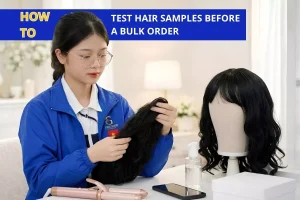
Ask to select items at random from an agreed group, rather than relying on prepared display pieces. Have the host show the group first, then keep your chosen item visible while it is measured.
| Check | What to record |
|---|---|
| Weight | Reading without packaging and whether it represents hair or the complete finished product |
| Length | Starting point, endpoint and whether curls are gently extended |
| Fullness | End appearance against the agreed reference for that length and grade |
| Construction | Weft seams, attachment sizes, lace area and relevant cap measurements |
For wigs, confirm the lengths used in the wefts and closure or frontal. Measuring only the longest strands leaves part of the construction unexplained.
Agree on sample-testing terms before washing, coloring or damaging any item.
Check shedding and surface feel gently
Support the weft or cap and finger-comb with consistent, gentle pressure. Record released strands separately from broken pieces. Avoid forceful pulling, which can damage the item and makes comparisons unreliable.
Feel a small section from root to tip, then gently in reverse. Note roughness and snagging, but do not treat smoothness as proof of intact, aligned cuticles or Remy status. Surface treatments and wetness affect hair friction, so record the condition in which you handle the sample.
Treat bleaching and burn tests as limited evidence
If your business needs hair suitable for lightening, ask a qualified colorist to test a separate sample against your intended shade, which may include #613. Record the starting color, products, conditions and result after rinsing and drying.
Reaching blonde does not prove the entire product is human hair. Examine breakage and manageability too, because bleaching can alter hair structure and mechanical properties.
Burning a few strands also cannot certify a whole bundle. Blended fibers can make burn-test results difficult to interpret, and burning alone is not conclusive. Avoid impromptu flame demonstrations beside hair stock; use suitable laboratory analysis when composition is disputed.
Observe wet stretch and curl recovery
With permission, wet a small section, gently extend it and release. Note breakage or failure to recover, then assess the curl pattern again after drying under agreed conditions. Curl recovery and fiber elasticity are different observations; neither predicts lifespan from one demonstration.
Find out what QC actually checks
Locate the quality control area and ask who makes acceptance decisions. Request a demonstration of length measurement, shedding assessment or tangling checks, plus an anonymized inspection record.
Ask whether each check covers every unit or selected samples. “Every bundle inspected” needs a clear explanation of the inspection scope.
Watch what happens to an item that fails. Is it separated, corrected and checked again? Can the result be connected to a product or batch reference?
Before accepting a product, agree on measurable limits and acceptable variation. A quick comb-through cannot replace a proper wash-and-wear evaluation.
Discuss capacity, customization and communication
Ask for monthly output and typical bulk-order production time, then narrow the answer to your exact products. Capacity stated in kilograms cannot directly tell you how many finished wigs of your specification are available.
Discuss current commitments, material availability and the slowest production stage. Request recent output records or a production schedule with confidential details removed. Separate production time from transport time.
Confirm minimum order quantities for samples, wholesale orders and custom work. Ask whether custom labels, packaging or cap construction have separate minimums, costs or approval steps.
Judge communication by accurate explanations and follow-through. A salesperson who brings in a technician may be more useful than someone who answers every question immediately.
Keep a live video tour interactive
Use WhatsApp, FaceTime or Zoom to ask for movements and close-ups as the visit unfolds. Request a return to a workstation, a different camera angle, or measurements of an item you select.
If you want a short-notice check during local working hours, ask whether it can be accommodated. An unanswered surprise call does not establish dishonesty.
Agree on recording permission. Where access is restricted, ask why and arrange another way to check the relevant claim.
Understand what factory documents prove
For claimed certifications, check the company name, site, scope, issuer and current status. ISO 9001 concerns a quality management system, not certification of an individual bundle’s origin or grade.
Finish by recording observed results, unresolved questions and the agreed follow-up. A short tour cannot establish future batch consistency.
FAQs About Hair Factory Tour Checklist
Should I order immediately after a good tour?
Approve representative samples first and resolve important gaps. A tour shows selected operations at a particular time.
Can I take samples away during a visit?
Ask beforehand about availability, payment and permission. Label each sample so it can be matched to the specification.
What if my product is not being made?
Schedule a follow-up during the relevant operation. Record which parts of the first visit were substitute demonstrations.
Can video show the exact hair color?
It can support an initial comparison. Approve shades with physical samples because lighting, cameras and screens affect appearance.
What should I request after the tour?
Request written answers to outstanding questions, a sample quotation, specifications and the proposed inspection arrangements.
Plan your next step with GreatHair
Contact GreatHair with your product requirements, quantity and preferred time zone to request a visit or live call. For pricing, send your details through our wholesale inquiry page. Then follow our hair sample testing guide before approving bulk production.