

A weft that looks perfect in the package can become a costly problem once your salon starts brushing it. Loose strands, recurring tangles and weak seams can lead to complaints, replacements and lost confidence in your supply.
At GreatHair, we work on these risks during production and inspection. We sort and align the hair, secure the roots within the weft, then check the finished construction. Brushing and seam checks help us catch shedding, recurring snags and weak sections before packing.
For Remy weft hair extensions, smooth lengths and secure attachment both matter.
Why Remy wefts can still shed or tangle
Remy describes how the hair is aligned. The weft construction determines how those strands are held. Well-aligned hair can still slip from weak stitching, while a firm track can hold hair that catches during brushing.
At GreatHair, we sort the hair and keep the strands in root-to-tip order before forming the weft. This helps reduce friction associated with opposing cuticle directions. The condition of the fibres also affects how easily the lengths move past one another.
The attachment method depends on the product. Conventional machine wefts hold the prepared roots in a sewn track. For our Genius Weft, we spread the roots evenly before securing them with a bonding layer and compact stitching. We then press the seam flat.
That preparation matters. A crowded patch of roots puts more material inside one part of the attachment line. Spreading them across the working width gives us a more even layer to secure. Each product needs seam checks and cutting instructions that match its construction.
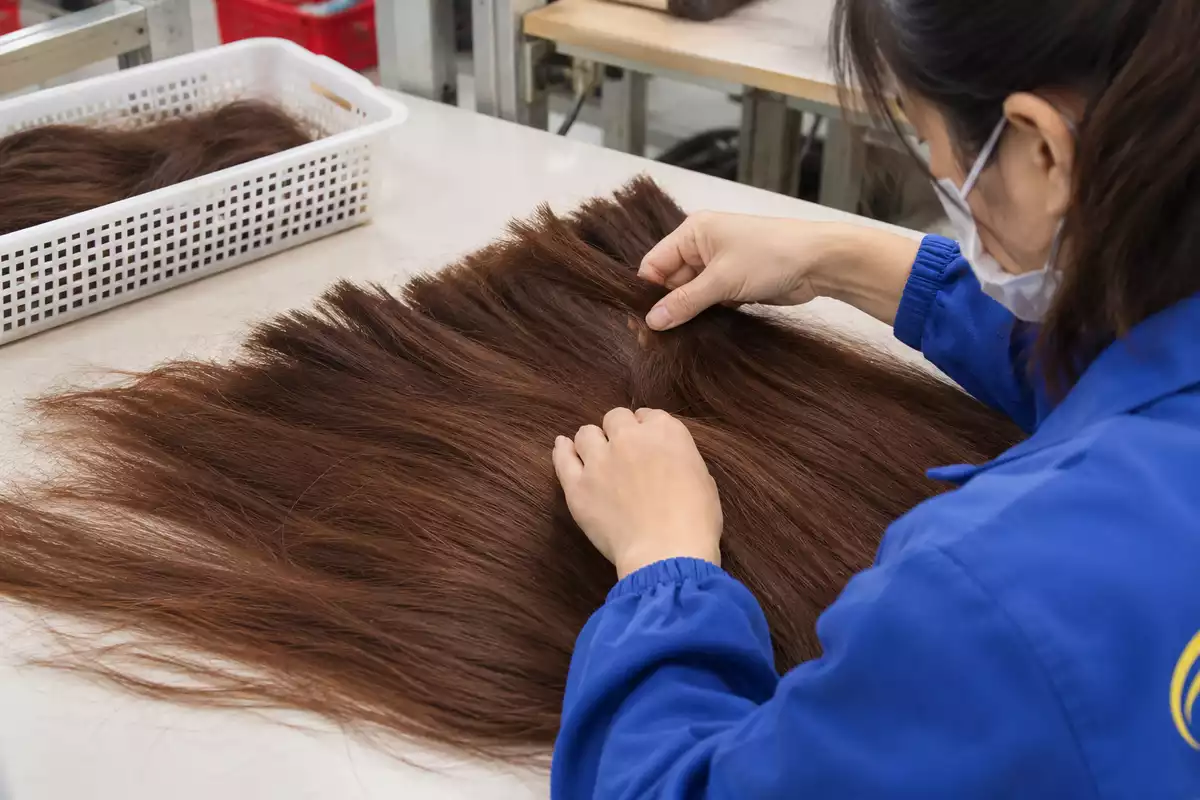
How we check shedding during brushing
If the brush keeps picking up loose hair, you need to know whether the strands are slipping from the weft or breaking along their length. Those two problems can look similar on the brush, but they lead us to different parts of the product.
We hold the track steady and begin at the ends, using a tool suited to the texture. Once that section is clear, we move higher, keeping each stroke directed down the hair. With the initial loose strands out of the way, another pass lets us watch the seam more closely. We pay particular attention to any point that keeps releasing hair.
If strands continue slipping out there, we check how the roots are held. Short broken pieces lead us to examine the fibres and any snag the brush is pulling through. The strand ends and the condition of the track help us tell the difference. A weak section goes back for correction or replacement, followed by another check.
How we check for recurring tangles
A sample can feel soft in your hand and still catch halfway through a comb-through. In a salon, that means extra time separating hair during sectioning and installation. What matters is whether the same area keeps catching after the knot has been cleared.
We stop where the comb catches and gently separate the affected strands. If there is a knot, we ease it apart before passing the comb through that area again. The hair should move more freely once the knot is clear.
If the comb catches again, we look for a remaining knot or damage along the fibres. Forcing it through risks breaking the hair before we have understood the problem. Hair that needs correction or replacement is checked again afterward.
We start reducing this risk before we make the weft, by sorting the hair and keeping the strands in root-to-tip order. The comb-through then lets us see how the finished lengths handle. How they respond after washing is a separate check.
How we inspect the weft seam and cut edges
A weft that combs smoothly can still come loose at its edge. This matters when you cut a strip to fit a row. You need the new end to hold together as you handle it.
We turn the strip over and follow the seam from one end to the other. Loose threads, separating layers or strands moving out of place show us where to look more closely. We also apply gentle tension by hand and watch whether the seam starts to open. This helps us spot visible faults; measuring pulling force would require suitable equipment and a defined method.
| Weft construction | How the hair is secured | What needs particular attention |
|---|---|---|
| Conventional single or double machine weft | A sewn track holds the prepared root section | Stitch integrity, strand retention and the required treatment of cut ends |
| GreatHair Genius Weft | A bonded root section works with compact stitching; pressing shapes the edge | Integrity of the attachment line, flexibility and how the edge holds after cutting |
Our Genius Weft manufacturing process explains how we make that edge suitable for cutting. For an agreed demonstration on a cuttable sample, we compare the end before and after the cut. After any edge treatment specified for the product, we check for separating layers or hair coming away during gentle handling.
If the edge separates or keeps releasing strands, we trace the problem to that part of the construction. The affected piece is corrected or replaced and inspected again.
The cutting instructions still depend on the construction. Traditional hand-tied tracks generally need to remain intact unless the supplier expressly permits cutting that exact product. Adding sealant does not make every weft suitable for cutting.
What happens when a weft fails QC
We set aside products that fail QC for correction or replacement. A weak attachment calls for work on the construction. Fibre damage may require replacement even when the seam itself holds securely.
The recheck returns to the fault we found. If strands were slipping from one section, we examine that section again during brushing. If the edge was opening, we inspect how it holds after correction. A neater appearance alone does not resolve either problem.
When the same fault remains, the piece stays out of the shipment for further correction or replacement. The corrected or replacement weft must clear QC before it is released. We also check bundle weight and length before packaging, so the final review covers the ordered specifications as well as the hair and track.
How to verify your weft before a wholesale order
GreatHair carries out its production and final checks before packing. A sample lets your team assess whether the weft suits the services or products you sell.
Choose the construction, hair type, colour, length and texture you intend to order. Keep the sample and its written specifications as a reference for the bulk purchase, including the agreed pack weight.
We provide photos and videos of the hair and parcel before dispatch. If you want a separate brushing or cutting demonstration, agree on the sample, method and available footage beforehand. For brushing, keep the track, tool and released strands visible. For a cut edge, a close-up of both sides before and after cutting is useful. Any footage of a recheck should identify the corrected or replacement piece.
Record the conditions alongside the result, including the tool, hair condition and number of passes where applicable. Our Vietnamese weft sample guide covers the wider sample-order process.
FAQs
Can Remy weft hair extensions still shed?
Yes. Remy describes strand orientation. Secure weft construction and appropriate cutting and handling also determine how well the hair stays attached.
How many strands should come away during a test?
Agree on the criterion for the sample and checking method. The amount of hair tested, tool, condition and number of passes all affect the interpretation.
Does every machine weft need sealing after cutting?
Requirements vary. Follow the cutting and edge-finishing instructions for the specific weft you order.
Does a smooth comb-through prove the hair is Remy?
It demonstrates handling under those conditions. Confirming cuticle direction requires additional evidence beyond how easily a comb moves through the sample.
Can I request a closer QC view before shipping?
You can request one. Describe the detail you want to see and confirm the available footage or separate test in advance, especially if it involves cutting a sample.
Check Your Remy Weft Hair Quality with GreatHair
GreatHair manufactures Vietnamese human hair products for salons, resellers and wholesale buyers. Checking a representative sample helps you spot handling or construction problems before committing to a larger stock order.
- Choose your weft. Send the construction, length, colour and texture you need.
- Request the QC details. Tell us whether shedding, tangling or cut-edge stability is your main concern so we can discuss suitable evidence.
- Get a sample quotation. Include the sample quantity, expected bulk quantity and delivery destination. Confirm the product and shipping costs before proceeding.
Contact GreatHair with those details to request product advice, available QC evidence and a sample quote.