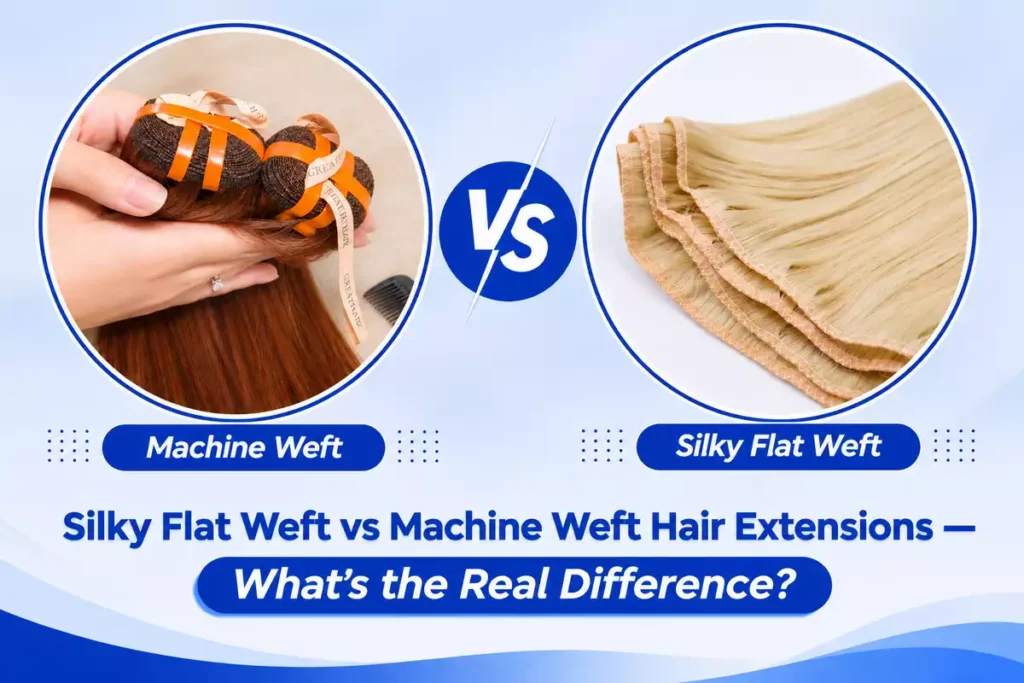
Silky flat weft hair extensions aim for a flatter attachment edge. Traditional machine weft hair extensions have a more visible sewn track. The choice changes how the attachment sits, how hair spreads along the strip, and which uses fit best.
This guide covers GreatHair’s Single Layer Silky Flat, Double Layer Silky Flat, and Machine Double Weft. Here, machine weft means that double-weft product, not every machine-made weft.
Three Weft Types in Brief.
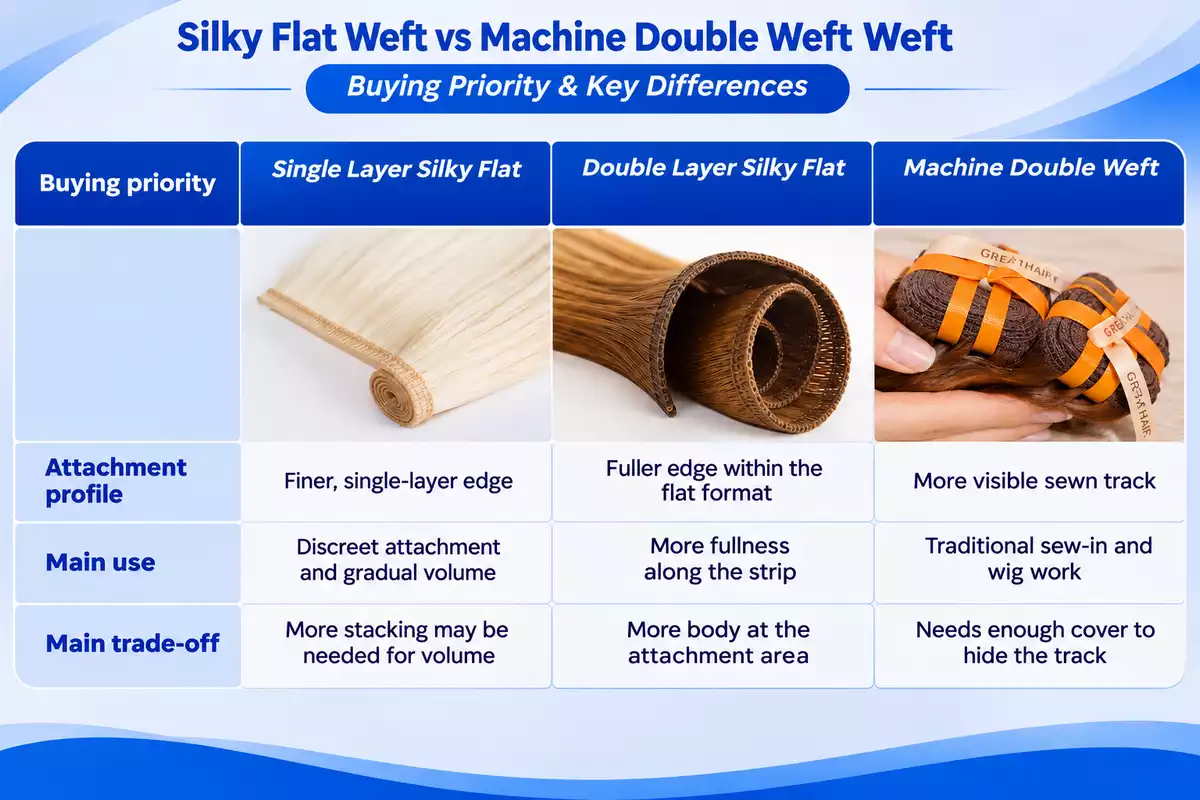
Single Layer Silky Flat Weft has one layer of hair along a slim, flat edge. It suits buyers who want a discreet seam and gradual volume changes.
Double Layer Silky Flat Weft combines two layers for a fuller strip within the flat-weft format. It has more body at the attachment area than the single-layer version.
Machine Double Weft secures the hair in a machine-sewn double-weft build. Its more substantial track suits traditional sew-in and wig-making work.
End fullness depends on the chosen hair and drawn quality in all three builds.
What Actually Changes Between These Wefts?
Seam Shape and Concealment.
The clearest difference shows when you view the attachment edge from the side.
Single Layer Silky Flat has less hair layered at the root than Double Layer. The double-layer version adds more body within the flat format. Machine Double Weft has a more pronounced stitched edge, so the finished style needs enough cover.
Check the samples on the same soft curve. Look at edge height, flex, and how it sits when layered. Extra stacking can make a slim strip feel fuller.
For Machine Double Weft, inspect both sides of the track for uneven stitching, raised sections, and loose threads. A strong seam should still be neat. Size alone does not prove durability.
Strip Width, Pack Weight and Coverage.
Weft width is the horizontal length of the strip. Hair length runs from the attachment edge to the ends.
Compare total width at the same pack weight, hair length, and drawn quality. Also confirm whether the quoted width refers to one strip or the full pack.
For example, 100g of finished weft spread across 200cm averages 0.5g/cm. Across 125cm, the same 100g averages 0.8g/cm. These figures include the attachment material. They show average product weight per centimetre, not hair-fibre weight alone.
The total weight stays the same; it is spread across a shorter strip. These are only examples, not GreatHair product specs.
GreatHair’s Machine Double Weft spec lists 100g per piece. Match that weight with the quoted strip width and hair grade for the exact length you order. Keep strip count clear when comparing it with a Silky Flat pack.
Fullness and the Need for Stacking.
Double Layer Silky Flat can reduce the need to stack extra strips when more fullness is wanted along the same span. Single Layer gives finer control when building volume step by step.
Machine Double Weft should also be judged by how much hair sits along the usable track. Compare equal spans at matching lengths and grades. A bigger sewn edge does not, by itself, tell you how much hair hangs below it.
Fewer stacked strips do not always mean fewer attachment points, fewer installed rows, or less total weight. Those choices depend on the install plan and the wearer’s natural hair.
Describe added fullness along the strip apart from pack weight and end fullness.
End Fullness and Double Drawn Hair.
Double drawn weft hair extensions are sorted to remove more short strands, so the ends look fuller. Double Layer describes the build; Double Drawn describes the hair length mix.
A single-layer weft with fuller-end hair can look denser at the bottom than a double-layer weft with more short strands. Adding another layer cannot make short strands reach the listed length.
Match the drawn quality before you judge which build gives the result you want. Our guide to single drawn and double drawn hair explains the hair-choice difference.
Application and Cost.
Machine Double Weft is a practical sample choice for buyers who supply traditional sew-in services or make wigs with sewn tracks. In wig work, check how the track follows the cap and how each row sits next to the next.
Silky Flat is worth comparing when the attachment profile matters most. The single-layer and double-layer options let you weigh a finer edge against more fullness along the strip.
Traditional machine wefts are often seen as a lower-cost option. To find the real price gap, compare quotes for the same weight, hair length, colour, texture, and drawn quality. Build type is only one part of the cost.
Which Weft Fits Your Product Range?
Choose Single Layer Silky Flat as a starter sample when discreet attachment matters most. It suits product ranges built around a finer seam and careful volume control.
Compare Double Layer Silky Flat when customers want more fullness within the flat format. Check the finished profile against the amount of hair your customers expect.
Consider Machine Double Weft when your customers already use traditional sewn tracks. Its fit for their sew-in or wig-making workflow matters more than a broad claim that it is better for thick hair.
For salon use, assess strand thickness, natural hair density, and the planned installed weight together. Product names alone cannot prove fit.
Wholesalers, resellers, and hair brands can use the same checks to label their weft hair extensions clearly for wholesale weft hair lines and repeat orders. Keep the approved sample with its build, pack weight, strip count, width, length, colour, texture, and end-fullness rule. That gives your team a clear reference for repeat orders.
Compare Weft Samples With GreatHair.
GreatHair manufactures Vietnamese human hair products in a 5,000m² factory with more than 200 skilled workers. We supply wholesalers, distributors, resellers, hair brands, and salons.
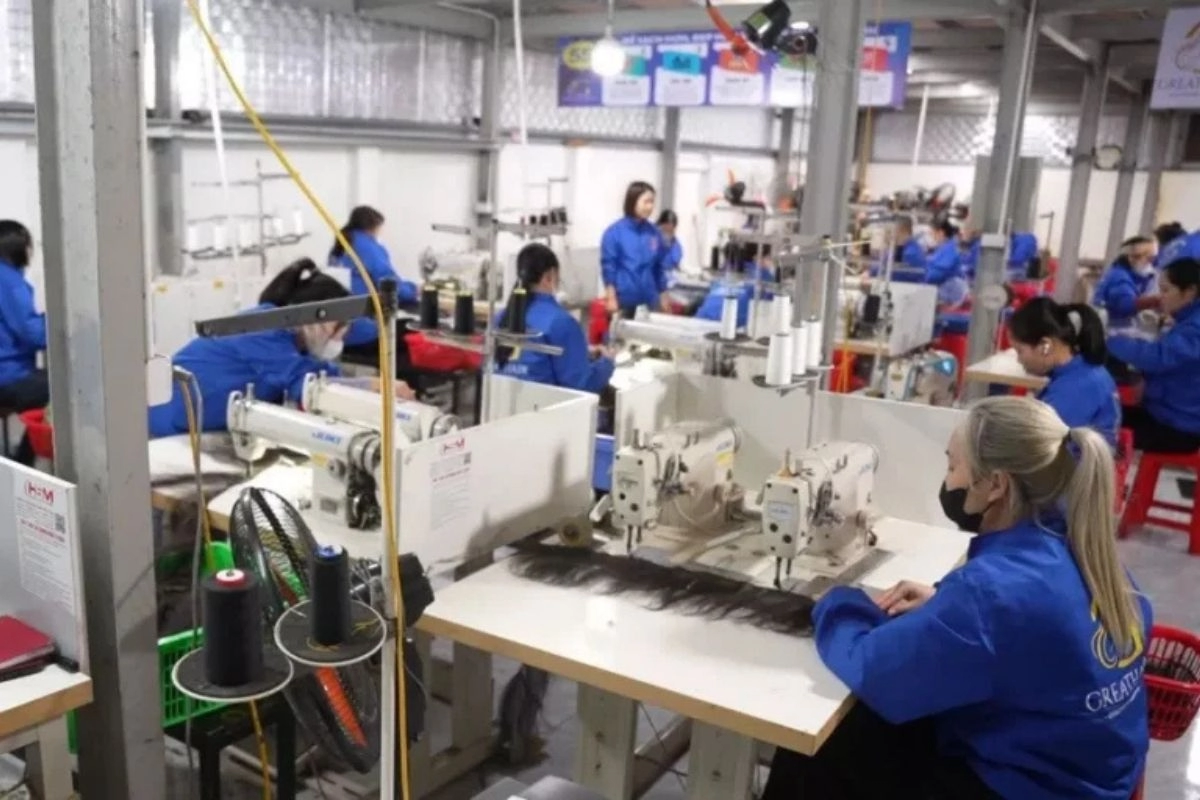
Our production team checks stitching after sewing, while our weft inspection process includes length and weight checks. Individual bundle checks and production photos or videos help you review the goods before shipment.
Tell us which weft builds you want to compare, along with the length, colour, texture, end fullness, and quantity you need. Ask us to confirm pack weight, strip count, and horizontal width for each sample. Contact GreatHair to discuss sample options and a wholesale quotation.
Q&A About Flat Weft vs Machine Weft Hair Extensions.
What should buyers compare first when choosing between Silky Flat and Machine Double Weft samples?
Start with the attachment edge and the planned use. Silky Flat options are mainly about a flatter, more discreet profile, while Machine Double Weft is better judged for traditional sewn-track work such as sew-ins and wig production. After that, compare pack weight, strip count, horizontal width, length, texture, colour, and drawn quality.
Why can two 100g wefts feel different along the strip?
The same total weight can be spread across different widths. If you spread 100g over a shorter strip, you will have more average product weight per centimetre than if you spread it over a longer strip. This does not automatically show better hair quality. The figure includes attachment material and does not measure hair-fibre weight alone.
When might Single Layer Silky Flat be preferable to Double Layer Silky Flat?
Single Layer Silky Flat is useful when a finer seam and gradual volume control matter most. It may need more stacking for fullness, but it gives buyers more control over how much volume is built into the finished application.
What information should be kept with an approved sample for repeat orders?
Keep the sample details together with its build, pack weight, strip count, width, length, colour, texture, and end-fullness rule. This helps wholesalers, resellers, brands, and salons compare future production against the approved reference.
Does a more visible machine-sewn track mean the weft is more durable?
Not by itself. Machine Double Weft has a more substantial sewn edge, but buyers should still inspect both sides of the track for neat stitching, raised sections, loose threads, and overall finishing. Track size alone does not prove durability.