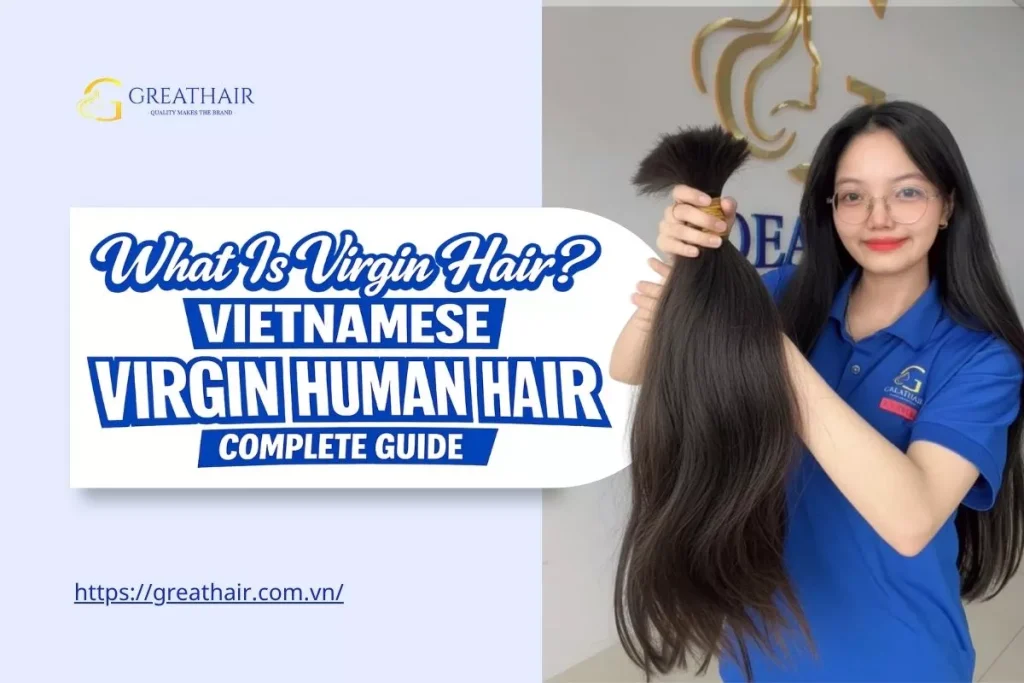
Vietnamese virgin hair generally refers to human hair collected from Vietnamese donors without previous chemical dyeing, bleaching or perming. The important detail is what happens after collection. A supplier may continue using “virgin” as a material name even when the finished hair has been colored or textured.
At GreatHair, we recommend choosing the finished product through its processing details, fullness and construction. That gives you a clearer basis for buying than the virgin label alone, whether you need bundles, a wig or salon extensions.
What does virgin mean when you buy finished hair?
Virgin describes treatment history, but supplier terminology can vary. Some suppliers use it for untreated finished hair; others use it for products made from virgin starting material.
If hair has been dyed during production, the finished item is colored hair made from virgin material. Calling it virgin should not hide that later treatment.
Our virgin material category can combine hair from multiple donors, sorted into different specifications. Single donor is a separate sourcing description. You should not assume that every Vietnamese virgin bundle comes from one person, or that mixed-donor hair automatically fails the virgin definition.
Ask two questions before comparing quotations. What does this supplier mean by virgin, and does that description apply before or after manufacturing?
Also confirm donor origin. Hair manufactured in Vietnam and hair collected from Vietnamese donors are different claims. The origin information should relate to the item you are ordering.
Can virgin hair also be Remy?
Yes. Hair can be both virgin and Remy because the terms describe different properties.
Remy means the strands follow the same root-to-tip direction, a definition also used in Great Lengths’ technical FAQ. The cuticle is the overlapping outer layer of the hair fiber. For a Remy claim, ask about both cuticle retention and alignment.
Virgin concerns chemical treatment history. Remy concerns direction. Donor count and end fullness are separate again.
| Buying term | What it tells you | What it does not establish |
|---|---|---|
| Virgin | The stated chemical treatment history | Donor count or end fullness |
| Remy | Root-to-tip alignment | Whether the hair was dyed or bleached |
| Single donor or mixed donor | The sourcing arrangement | A guaranteed color result or lifespan |
| DD, SDD or SDD Plus | A supplier’s fullness specification | Virgin status or identical strand lengths |
In GreatHair’s range, DD, SDD and SDD Plus identify different fullness options. For a blunt finish, pay particular attention to the amount of hair reaching the ends. For a layered finish, a more tapered distribution may suit your design.
We recommend comparing fullness at the same length and net hair weight. Grade names alone are insufficient when two suppliers define them differently.
Our Vietnamese hair buyer guide covers the wider relationship between origin, processing, grades and formats.
What should you know about color and texture processing?
Ask how the finished shade and texture were achieved. A photograph can show the appearance you want, but it cannot establish the complete processing history.
Natural color and factory coloring
A dark color does not automatically mean undyed hair. Confirm whether the supplied shade is the donor’s natural color or a factory-colored result.
A code such as 1B identifies a shade within the supplier’s color chart. It should be accompanied by a processing description if natural color matters to your purchase.
For blonde, ombré or other colored products, ask whether the hair was lightened, dyed or toned. These treatments should remain visible in the specification even when virgin material was used initially.
Natural texture and created texture
Straight, wavy and curly describe appearance. They do not, by themselves, explain how the pattern was obtained.
Ask whether the texture is naturally occurring, created using heat or steam, or chemically altered. A steam-set wave should be described as a created texture rather than presented as an untouched donor pattern.
If you plan to sell a particular wave or curl, request a representative sample and assess its appearance after the agreed washing routine. Confirm any surface finishes and ask how the texture should be maintained.
Is virgin hair suitable for bleaching and restyling?
Choose the material for your intended color result before ordering. The virgin label does not mean that every product can reach blonde without damage.
For our standard dark 1B virgin material, we recommend discussing darker brown applications rather than assuming suitability for a blonde transformation. If your plan involves light shades, specify that requirement so a suitable light-tone material or finished colored product can be considered.
Research on repeated bleaching has documented damage to the cuticle and internal hair structure under experimental conditions. Untreated starting hair is therefore not a guarantee against damage during later lightening.
That research is not a GreatHair product test. The achievable result for your order still needs confirmation through the selected material, processing history and an agreed strand test.
The right choice depends on the look you want to create. For dark straight bundles with a blunt finish, focus on shade, end fullness and weft quality. For a pale blonde wig, confirm the hair’s suitability for lightening before choosing the length or placing a bulk order.
For heat styling, follow the product’s care guidance and assess a sample using your intended routine. Avoid treating virgin as a promise of unlimited restyling.

Which product format fits your intended use?
Vietnamese virgin hair can be used in bundles, wigs, closures, frontals and several extension formats. Your application determines which additional details matter.
For weft bundles, confirm net hair weight, end fullness, length and weft construction. For wig making, coordinate the bundle specification with the closure or frontal, including shade and texture.
For a finished wig, check cap size, lace dimensions and density as well as the hair material. A description such as “virgin wig” does not explain how the cap will fit or where the volume is distributed.
For tape-ins, tips or clip-ins, confirm attachment construction and weight per piece. The material name does not determine whether an installation method suits your natural hair or maintenance preferences; discuss that choice with your stylist.
We recommend starting with the result you want, then selecting the format and material together. Our guide to choosing hair products for your business develops that decision further.
What should the product record include before you order?
Request a written specification for the exact product you plan to sample.
- Material and sourcing: Human hair content, donor origin, donor arrangement and the meaning of virgin.
- Finished processing: Natural or colored shade, texture method, surface finishes and later coloring restrictions.
- Length and fullness: Measurement method, grade definition, end appearance and agreed tolerances.
- Weight and construction: Net hair weight and the relevant weft, attachment, lace or cap specifications.
- Commercial terms: Price unit, sample quantity, bulk quantity, delivery costs and production time.
- Approval conditions: What you may test, how discrepancies are reported and the applicable return terms.
Choose a sample matching the proposed finished product. A dark straight bundle cannot fully represent a blonde textured wig.
Record the condition on arrival before washing, coloring, cutting lace or installing the hair. Confirm testing conditions first, because alterations can affect return eligibility.
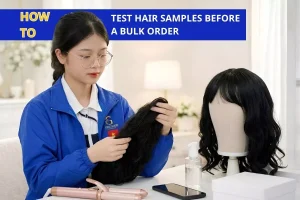
We highly advise our wholesale partners to test hair samples before bulk order. If you approve the sample, retain it with the agreed specification as a reference for future shipments. If you approve the sample, retain it with the agreed specification as a reference for the bulk order. It helps you compare deliveries, although one sample cannot establish the performance of every future batch.
FAQs About Vietnamese Virgin Hair.
Does virgin mean the hair has never been washed?
No. Washing and cleaning are different from chemical coloring, bleaching or perming. Ask separately about processing and any finishing products.
Can washing a sample prove its origin or virgin status?
Washing helps assess the sample’s behavior under your routine. It cannot establish donor origin or the complete treatment history, so keep the supplier’s written descriptions.
Can I combine different bundle lengths?
Yes, if they suit your planned style. Confirm the length distribution, total weight and matching shade and texture with your stylist or wig maker.
Why do two virgin-hair quotes have different prices?
Compare the finished specifications and units. Length, fullness, color, texture, construction and order quantity can differ even when both products carry the virgin label.
Can I return a sample after bleaching it?
Confirm the terms before processing it. Do not assume that bleaching, washing, installation or other alterations leave the sample eligible for return.
Choose your specifications and request a sample

Tell us the product format, length, weight, fullness, color and texture you need, along with any plans for further coloring.
Contact GreatHair to discuss your requirements and request a representative sample. Ask for the processing description and current sample terms with your quotation, so your next decision is based on a defined product.